
Organisations invest heavily in Employee Engagement, expecting a clear return: a better culture, stronger performance and higher retention. The data justifies this investment. According to research by Gallup, companies with highly engaged teams experience a 23% increase in profitability1.
However, Employee Engagement doesn't improve simply by asking questions; it improves when people feel safe enough to answer them honestly. Creating that environment starts with anonymity, which empowers people to speak freely and ensures feedback reflects reality rather than what employees think their organisation wants to hear.

Why People Don’t Survey: Overcoming the 3 Main Barriers
Before looking at the benefits of an external partner, we must address why employees often hesitate to participate in surveys at all. Research shows that there are three primary reasons for low participation:
- Lack of Trust in Anonymity: The number one reason people won’t fill out a survey is the fear that their responses aren't truly anonymous and could lead to repercussions.
- Survey Apathy: If employees have given feedback before and seen zero action, they become cynical. Why spend 15 minutes on a survey if it feels like it disappears into a black hole?
- Survey Fatigue: Overly long, complex or too-frequent surveys (common with in-house tools) lead to ‘click-through’ behaviour where employees rush to finish without providing meaningful thought.
From Insight to Impact: Why an External Partner is Essential
To overcome these barriers and turn feedback into fuel for your business, you need a process that is both trusted by employees and scientifically rigorous.
Here are five reasons why an anonymous, independent survey outperforms an internally run survey every time:
1. Anonymous Surveys Deliver More Candid Feedback
Employees are far more likely to tell the truth when they know their responses cannot be traced back to them. In-house surveys often create a fear of reprisals; employees self-censor because they worry their manager might see their specific comments.
Independent surveys remove these fears, allowing for honest feedback on sensitive topics like Leadership Trust, Manager Behaviour and Wellbeing.
2. Higher Participation Through "The Third-Party Effect"
Trusting the process is the fastest way to boost response rates. Data indicates that third-party managed surveys typically see a 10-15% higher participation rate compared to internally managed ones2. When an organisation like Best Companies manages the process, it creates a ‘firewall’ that guarantees confidentiality and prevents employees’ fear of being identified and ostracised for honest feedback.
3. Benchmarking Unlocks Strategic Context
An in-house survey might tell you that 70% of your staff are happy, but is that actually good? With an external approach, you gain access to:
- Industry Standards: Compare your scores against peers in your specific sector.
- Top Performers: See how you stack up against the best-performing brands nationally.
- Gap Analysis: Identify if a low score is an industry-wide trend or a specific internal issue you need to address.
- A Methodology Built on 25 Years of Rigour
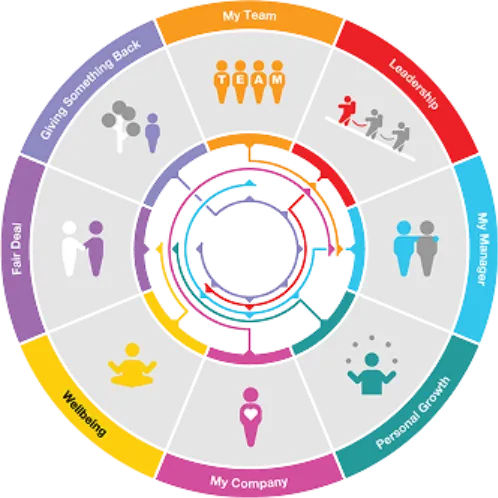
Rather than using a simple ‘dip-stick’ poll, Best Companies utilises the 8 Factor Framework, a methodology that is fundamentally different from standard in-house tools.
- Academically Validated: Developed in collaboration with academics from the University of Plymouth, combining over 60 years of research expertise.
- Massive Data Scale: Built on the insights of more than 6 million employees surveyed over 25 years, making it one of the largest ongoing studies of workplace engagement.
- Statistical Precision: Unlike many tools that use ‘gut-feel’ questions, the Best Companies model was created using Exploratory Factor Analysis to identify what truly drives engagement, and is re-validated annually using Confirmatory Factor Analysis to ensure the 24 core statements remain the most accurate measures of Organisational Health.
5. Data You Can Actually Act On
Internal surveys often result in data dumps; huge spreadsheets that are difficult to interpret. Because the Best Companies 8-Factor Methodology is scientifically rigorous, the data provides a reliable baseline for strategic decision-making. You stop guessing where to invest your culture budget and start targeting the specific ‘Factors' that will drive the most significant improvement in your Employee Engagement and Organisational Health, and, as a result, in profitability and retention.
Turning Insight Into Sustainable Change
The most successful organisations understand that an engagement survey is not just an HR checkbox, it is a strategic diagnostic tool. By choosing an external, anonymous partner, you move beyond taking the temperature and begin a genuine dialogue with your workforce.
When employees see that their voices are heard through a secure, scientifically-backed platform, trust increases and a culture of continuous improvement takes root. Ultimately, the transition from in-house polling to professional, independent measurement is the difference between simply collecting data and truly transforming your workplace.
