

Mergers are often heralded as strategic triumphs in boardrooms, but on the ground, they are experienced as ‘shocks to the system’. For leadership, the focus is frequently on operational synergy; for employees, the experience is defined by ambiguity.
Research from Advances in Research (2024) identifies a phenomenon known as 'Merger Syndrome'1 - a state where employees face a perceived 'psychological strain', leading to feelings of job insecurity, loss of control and emotional detachment. Without a structured way to measure and address these feelings, the very talent that made the merger attractive can quickly become its biggest flight risk.
Using the Best Companies 8-Factors of Workplace Engagement, we can pinpoint exactly where the cracks typically appear during a merger and how proactive organisations can buck these trends to drive Organisational Health.
Organisational Health: Healthy organisations have performant People Leaders that build trust and, as a result, highly engaged employees.
During a merger, these five Factors typically take the hardest hit.
When leadership guidance is unclear, it creates a challenging ripple effect across the organisation.
Without a well-defined direction from the top, managers often find themselves lacking the necessary information to effectively guide their teams, which directly impacts their My Manager performance scores. This gap in clarity can lead to a decline in trust toward executives and weaken the sense of Psychological Safety, as employees naturally begin to feel uncertain about organisational stability.
Over time, this ongoing ambiguity strains employee Wellbeing, increasing the risk of burnout and leaving teams feeling overwhelmed. Ultimately, when overall wellbeing declines, it changes how employees perceive their compensation and recognition, often leaving them feeling that their efforts are underappreciated.

On the other hand, mergers can sometimes strengthen certain areas if managed correctly. When external pressure increases, teams often ‘circle the wagons’, leading to an increase in peer-to-peer support (My Team).
Seeing strong My Team scores in your Employee Engagement data during a transition is a significant strategic opportunity. It indicates a high level of peer-to-peer trust and accountability that keeps operations running even when the view from the top is blurry. However, leadership must look closer: is this bond fuelled by a unified drive, or is it a defensive ‘us vs. them’ mentality?
While tight-knit teams can sometimes create silos or resistance to change, savvy leaders view these high scores as a map of the organisation's informal influencers. These influencers are the ‘bridge-builders’ who can help translate new corporate goals into local team actions.
Rather than viewing these insulated groups as obstacles, leaders can lean into this existing team pride. By identifying the people driving these high scores and involving them in early win projects, you can pivot that internal loyalty toward the new, unified organisation. The goal is to evolve the mindset from "protecting my immediate team" to "driving the new, high-performing culture", using the existing social capital as the foundation.
How one organisation used data to navigate a 2025 merger.
The brand serves as a powerful example of how measuring Employee Engagement during a transition allows leadership to identify exactly where to intervene. Their 2024–2025 data, gathered from two surveys, one completed one month after their merger and the follow up a year later, reveals a fascinating story of bucking the trend in some areas while facing the reality of mergers and acquisitions in others.
The following table tracks the shift in score across four Best Companies Employee Engagement Factors, comparing the results of the initial post-merger survey with the follow-up 12 months later.
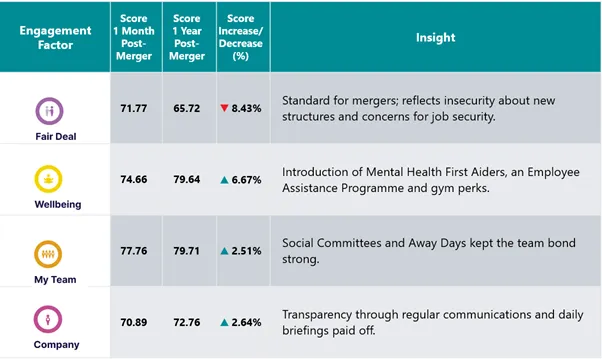
While most organisations see a decline in engagement during a merger, this brand actually saw an 8.2 point Best Companies Index (BCI) score increase. Why?

When leadership fails to provide a clear narrative, employees naturally default to protective behaviours:
Our data shows that the most effective strategy for ensuring that employees remain engaged with the business is through providing Organisational Clarity.
The purpose of Organisational Clarity is not to provide assurance, but rather to offer transparency. When employees can understand the situation and see the vision for how the business aims to move forward, they are more equipped to help the organisation to achieve its aims.
The most successful organisations prioritise two-way communication - enabling their people to voice concerns and solutions, thereby creating ownership and buy-in - and empower frontline managers to overcommunicate Organisations Clarity. Here is the blueprint for maintaining engagement:
Measuring Employee Engagement during a merger isn't just about collecting data for a board report; it is a signal to your employees that their experience matters. As seen with this Leisure & Hospitality Brand, even when factors like Fair Deal take a hit due to the natural uncertainty of a merger, an organisation can still thrive by strengthening in other factors.
A merger is, at its core, a collision of different cultures, legacy values and ways of working. Without intervention, this often leads to employees feeling siloed, retreating into the safety of ‘how we used to do things’. By focusing on My Company, leadership can bridge this gap, fostering a sense of Psychological Safety where employees feel secure enough to embrace a new, shared identity rather than protecting an old one.
By listening to the data and acting on it under the mantra of ‘you said, we listened, we improve together', leaders can transform a period of high anxiety into a moment of cultural evolution.