
Every year, organisations around the world launch their annual Employee Engagement surveys. HR departments analyse the data, leadership teams review the graphs and, a few weeks later, a company-wide email goes out boasting a familiar corporate mantra:
‘You Said, We Did.’
It sounds efficient. It sounds responsive. But more often than not, it results in solutions that fall completely flat.
Consider a common scenario: a survey reveals that employees are feeling deeply burnt out. In response, executive leadership decides, "We did! We bought everyone a subscription to a mindfulness app and mandated a 'No-Meeting Friday' once a month”.
Meanwhile, the actual issue on the ground was a flawed software rollout that doubled everyone’s daily admin tasks, or a critical understaffing issue in customer support. The ‘solution’ didn't fix the problem because it was devised in a vacuum. ‘You said, we did’ creates a transactional, top-down dynamic. It turns feedback into a laundry list for executives to check off, treating employees as passive complainers rather than active partners.

Shifting the Paradigm: ‘You Said, We Listened, We Improve Together’
To build genuine Organisational Clarity - where everyone understands not just what the company is doing, but why - organisations need to shift from a transactional mindset to a collaborative one.
This is the essence of ‘You said, we listened, we improve together’.
[Traditional] You Said ───> We (Leadership) Did ───> Disconnect
[Clarified] You Said ───> We Listened ───> We Improve Together (Co-Creation)
When an organisation adopts this philosophy, the survey results aren't treated as a mandate for immediate, executive-level fixes. Instead, they are treated as the beginning of a conversation.
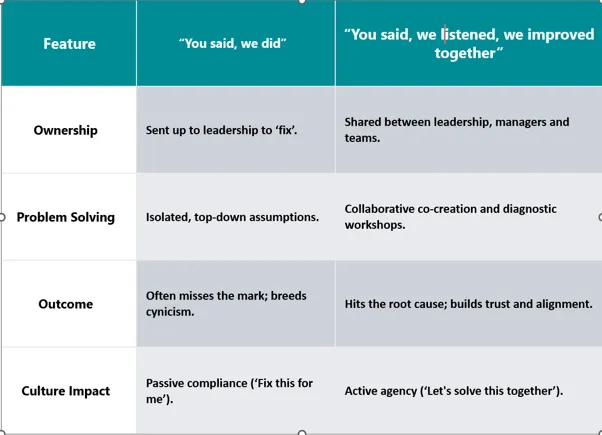
Listening means acknowledging the data points (‘We see that stress levels are high’). Improving together means sitting down with the people who highlighted the issue to diagnose why it’s happening and co-creating the cure.
Managers as the Architects of Organisational Clarity
If leadership sets the vision and the teams provide the raw feedback, it is the line managers who act as the vital bridge between the two. Without capable managers, the shift to ‘improving together’ is virtually impossible.
Managers are uniquely positioned to translate high-level data into localised reality. They provide Organisational Clarity in three distinct ways during the post-survey process:
1. Contextualising the Data
In a Best Companies survey, data is categorised into the 8-Factors of Workplace Engagement (My Team, Leadership, My Manager, My Company, Personal Growth, Wellbeing, Fair Deal and Giving Something Back). While HR and executives look at the macro Best Companies Index (BCI) score, a corporate-level dashboard cannot tell a story on its own.
For example, if your department sees a low score in the ‘My Company’ or ‘Fair Deal’ factors, senior leadership might instinctively assume people just want a pay rise or a generic corporate update.
A line manager, however, looks at that b-Heard data and localised heatmaps to open a real dialogue. They can ask the team: "Our 'My Company' score tells us we don't feel a strong sense of pride or alignment. Let's look at the specific statements, is it that we don't understand where the business is heading, or do we feel our daily work doesn't connect to that vision?" By breaking down the specific b-Heard metrics with the team, the manager accurately diagnoses the problem before anyone spends time building the wrong solution.
2. Acting as the Strategic ‘Middle Man’
Managers sit in the sweet spot of the corporate hierarchy. They have enough proximity to leadership to understand the broader business constraints (budgets, strategic goals, market pressures), and enough proximity to their teams to understand daily operational friction.
When a team suggests a solution that is completely unfeasible due to budget constraints, the manager doesn't just say "no". They provide clarity by explaining the why, and then help the team pivot to realistic, high-impact alternatives. Conversely, they advocate upward, ensuring leadership understands the genuine blockers their teams face.
3. Facilitating Co-Creation (Not Dictating Solutions)
The best managers don't look at survey results and say, "Okay team, here is how we are going to fix our collaboration score". Instead, they facilitate. They host post-survey workshops where they share the team's data, ask open-ended questions and guide the team toward defining their own action plans.
The Psychology of Ownership: People rarely support ideas they had no part in creating. When employees help design the solution to a survey challenge, they are naturally invested in making that solution work.

Actionable Steps for Managers to Drive Clarity
To successfully execute the ‘Improve Together’ framework after your next Employee Engagement survey, managers can use this straightforward sequence to guide their teams from feedback to action:
1.Share and Validate: Within 2-3 weeks of data release.
Bring the team together to review their specific survey scores. Avoid being defensive about low marks. Instead, validate their experience by saying: "The data shows we feel disconnected from the wider company strategy. Does that feel accurate to you?".
2.Run a Diagnostic Discussion: Focus on the 'Why'.
Before jumping to solutions, dig into the root causes. Find out exactly where the friction lies in their day-to-day workflows.
3.Co-Create 1-2 Micro-Actions: Keep it manageable.
Don't try to fix everything at once. Ask the team: "What are one or two things within our direct control that we can change this month to improve this score?". Write these down as shared commitments.
4.Establish a Feedback Loop: Maintain Organisational Clarity.
Keep the conversation alive. Dedicate five minutes in bi-weekly team meetings to check in on the action items. This ensures the team sees that their feedback wasn't a checkbox exercise, but a living project.
True Engagement is a Shared Journey
Employee Engagement surveys are not an evaluation of how well leadership can guess what employees want. They are an evaluation of how well an organisation can converse with itself.
By shifting the narrative from a transactional ‘We Did’ to a collaborative ‘We Improve Together,’ organisations foster deep trust. And by empowering managers to act as the champions of this dialogue, companies ensure that clarity filters down to every single desk, turning feedback into meaningful, lasting progress.