
For HR Executives, the value of Employee Engagement surveys is deeply intuitive. We see the human element: the burnout, the motivation, the team dynamics and the cultural alignment. But when you step into the boardroom to request budget for an Employee Engagement survey or a subsequent culture initiative, leading with ‘improving morale’ or ‘making people feel valued’ often misses the mark.
Board members are fiduciary stewards. They think in terms of risk mitigation, capital allocation, asset utilisation and shareholder value. To secure their buy-in, you must bridge the gap between people analytics and the financial bottom line.
If you want to shift the Board from passive observers to active sponsors of your engagement strategy, you must stop talking about feelings and start talking about figures. Here is how to translate Employee Engagement into the metrics the Board actually prioritises: productivity, profitability and retention.

1. Frame the Macro Risk: The Cost of Doing Nothing
Before presenting a solution, establish the cost of the status quo. Disengagement is not an abstract culture issue; it is a massive, invisible drain on corporate capital.
According to Gallup’s State of the Global Workplace report, low Employee Engagement costs the UK economy an astonishing £257 billion annually in lost productivity1, which equates to roughly the entire annual cost of running the NHS1.
When employees are quiet quitting or actively disengaged, the company is effectively paying 100% of a salary for a fraction of the output. When framing this to the board, position the value of an Employee Engagement survey as a diagnostic audit designed to locate and reclaim leaked organisational capacity.
2. Connect the Value of Employee Engagement Directly to the Income Statement
Board members are laser-focused on ‘Earning before interest, taxes, depreciation and amortisation’ (EBITDA) and profit margins. Fortunately, decades of data show that high-engagement cultures directly supercharge financial performance.
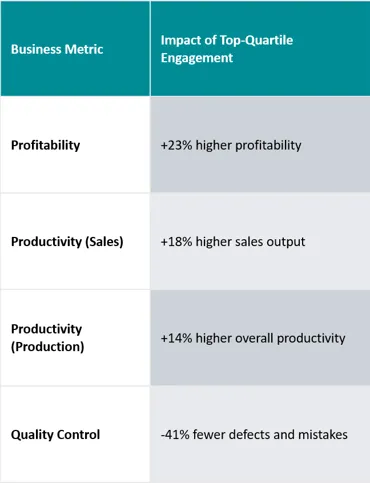
Gallup’s extensive meta-analysis of over 100,000 business units reveals a stark contrast between organisations in the top quartile of Employee Engagement versus those in the bottom quartile2:
The Boardroom Pitch:
"An investment in measuring and actively managing our engagement levels isn't about making employees happier; it is a direct lever to boost our operational efficiency by up to 14% and protect our profit margins by up to 23%."
3. Position Retention as Capital Preservation
Replacing an employee is an expensive capital drain. Between recruitment costs, onboarding, lost institutional knowledge and the time it takes a new hire to reach full productivity, losing a key staff member is financially damaging.
The data shows a massive correlation between how connected a workforce feels and their likelihood to stay. In high-turnover organisations, top-quartile engagement results in 18% lower turnover; in historically low-turnover industries, that gap widens to 43% lower turnover3.
When presenting to the Board, calculate your internal cost of turnover (typically 1.5x to 2x an employee's annual salary) and show them the math:
"A 10% reduction in our involuntary turnover saves this company £X,XXX,XXX annually. Our proposed Employee Engagement survey is the data-gathering mechanism required to build the targeted retention strategies that will save us that capital."

4. Sell the Survey as Your Strategic "GPS"
A common pushback from the Board is, "Why do we need a complex survey? Can't managers just talk to their teams?".
The counter-argument is data integrity. A board would never approve a corporate acquisition or a major product launch based on ‘gut feel’ or casual conversations; they require rigorous data, market analysis and risk assessments. An Employee Engagement survey is no different. It is a structured, quantitative instrument designed to give the executive team an accurate roadmap.
Explain to the Board that the survey serves three critical structural purposes:
- Identifying Micro-Cultures: In any company, engagement varies wildly by department. A survey isolates whether a retention risk is company-wide or localised to a specific division or leadership layer.
- Establishing a Baseline: You cannot manage what you do not measure. The survey creates a benchmark against which future leadership interventions can be numerically evaluated.
- Mitigating Risk: Low engagement is a leading indicator of operational risk, including safety incidents (which drop by 64% in highly engaged teams4) and compliance failures.
5. The Final Pitch: Data-Driven Execution
Conclude your presentation by demonstrating that you are not just collecting data for data's sake, but that you have a framework to turn those insights into operational outcomes.
Remind the Board that according to research, 70% of the variance in team engagement is directly tied to the quality of the manager5. The survey data will allow HR to target leadership training and resources precisely where they are dragging down productivity, ensuring maximum return on your HR budget.
By shifting your vocabulary from HR terminology to corporate finance terms, you transform the value of an Employee Engagement survey from a "nice-to-have" initiative into an essential component of the company's risk management and growth strategy.