

The world of work is at a tipping point. For decades, progress was defined by technological leaps - from steam engines to smart factories - but today, the question isn’t just about systems and tools, it’s about people. Are your managers, teams and leaders truly prepared to thrive in a future where human potential is more valuable than ever?
Jonathan Austin, CEO and founder of Best Companies, explored this critical topic in his recent keynote at the Employee Engagement Summit. His message was clear: the future of work isn’t about replacing humans with technology, it’s about, “People and machines working together to drive innovation, unleash potential and lead real change”.
And for Chief People Officers and HR leaders, this shift demands urgent attention.
Industry 4.0 was all about digital transformation, focusing on automation, AI, big data and smart systems. It delivered speed and efficiency, but it left a critical gap: human innovation. Technology raced ahead, while culture and leadership lagged behind.
Now, we’ve entered Industry 5.0, a new era where human creativity, critical thinking and collaboration take centre stage. Technology is taking on a supportive role, amplifying what people do best rather than replacing them. This is the moment where organisations must pivot from tech-first to people-first strategies.
For HR leaders, this means asking:
Jonathan referenced Everett Rogers’ Law of Diffusion of Innovation, which explains how new ideas “spread through five groups, from innovators to laggards”.
These five groups are the innovators – the risk takers, then comes the early adopters, followed by the early majority (those that wait for the clear benefits to be apparent), then the late majority and finally the laggards.
Between 2020 and 2025, Industry 5.0 sat with innovators and early adopters. But in 2025, we’ve crossed into the early majority. Change is no longer optional, it’s mainstream.
If your organisation hasn’t begun the shift to human-centric leadership, the question is: when will it?. And if not now, why not? Because once the tipping point is crossed, catching up becomes exponentially harder.
To understand where we go next, Jonathan traced the evolution of workplace thinking:
This progression reflects a fundamental truth: work has shifted from system-driven efficiency to human-centred effectiveness. And now, in Industry 5.0, the challenge for organisations is clear: how do we lead our people, creating engaged and high-performing teams, in a world where technology and humanity coexist?
For 25 years, Best Companies has measured what drives engagement and performance. Our research - over 6.5 million individual responses from 5,500+ organisations - reveals that organisational health is the foundation of sustainable success.
Our 8-Factor model measures what truly matters:
High scores across these factors indicate a healthy, high-performing organisation. But one issue consistently emerges: misalignment. People lack clarity about purpose, direction and their role in the bigger picture.
To solve this, we developed the Organisational Clarity Model, which defines four essentials:
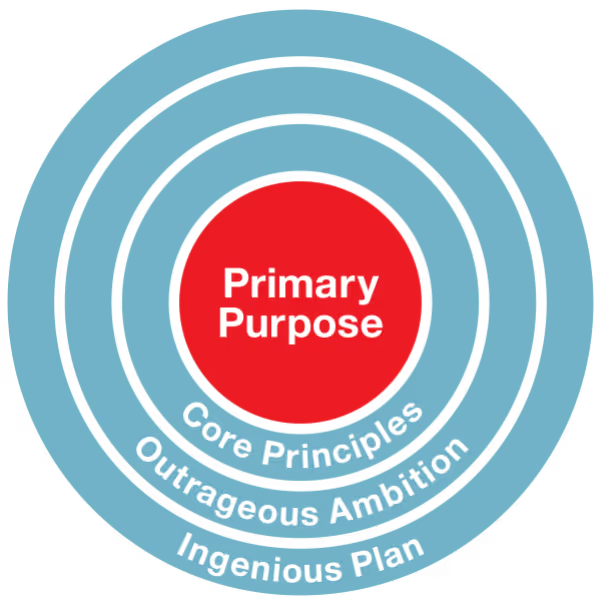
When clarity is missing, performance suffers. When it’s present, everything works. For HR leaders, this means embedding clarity into every conversation, every strategy, and every manager’s toolkit.
No single role impacts engagement more than the manager. However, too often organisations and managers are focused on the ‘business’ aspect of management; the KPIs and hitting targets.
With the shift into the human-centric Industry 5.0, managers need to be empowered to become people leaders, focusing on supporting the people in their teams, ensuring that their wellbeing and needs are taken care of to drive engagement and create high-performing teams.
That’s why we created the People Leader Index, integrating clarity, team performance and one-to-one engagement into a single actionable view.
Future-ready people leaders:
This isn’t about making management more complicated, it’s about making it intentional. Because when you unlock the powers of people leadership, you unlock scalable, sustainable performance.
AI and digital tools are transforming decision-making, communication and learning. But the real change isn’t the tech, it’s how we lead. Supported by platforms like Elevate, managers gain the insight and structure they need to thrive in Industry 5.0.
A future-ready workplace is inclusive, intentional and built around people. That’s what makes it sustainable. That’s what makes it successful.
Jonathan Austin dives deeper into these insights in the podcast hosted by Engage Employee: Is Your Workforce Future-Ready?
Engage Employee podcast brings you the hot topics and tips in the employee engagement industry. Hear from a range of industry leading brands, including Mercedes, Ericcson, Virgin Media, Fortnum Mason & more, as they share their journeys, success stories and future plans that you can implement into your business.
The future of work is here. It’s human-centric, tech-enabled and accelerating fast. For CPOs and CHROs, the mandate is clear:
Because the organisations that thrive in Industry 5.0 won’t be those with the smartest system, they’ll be those with the strongest people.