

Most of us have experience working for a 'bad' manager - in fact, 80% of us have done1 - but how often is this the manager’s fault? After all, being a bad manager doesn’t necessarily mean that they are a bad person. On the contrary, people are usually promoted to the manager level due to their technical ability. However, where there is a skill gap in in their people leadership skills.
This means that these managers are excellent at 'being in the trenches' with their teams but struggle to help coach and develop their direct reports.
And this is backed by data, with 83% of people feeling respected by their manager but only two in five believing their manager has received sufficient training in their role2.
This has popularised the term: the accidental manager.
Across organisations, accidental managers are everywhere. They’re the high performers who excelled in their roles and were promoted into leadership, often without formal training or preparation. While their technical skills shine, their people leadership skills are often underdeveloped. And that gap is costing your organisation more than you think.
The concept of the accidental manager isn’t new. It traces back to the Peter Principle (1969), which suggests employees are promoted until they reach their level of incompetence. In modern workplaces, this manifests when top performers are elevated into management roles without the skills or desire to lead.
This is a structural flaw in how organisations approach career progression. Success in one role doesn’t automatically confer readiness for the next. Yet, many businesses still treat people leadership as the default next step rather than a distinct skill set requiring preparation.
Recent research paints a stark picture: 52% of all UK managers have no formal management qualifications, and 26% of senior managers have never been trained3.
This isn’t just a leadership gap, it’s a cultural and financial crisis.
However, Best Companies data shows that organisations that focus on building a positive culture where managers are empowered to become people leaders, see higher levels of organisation clarity, engagement and performance in their teams.
Managers and Team Leaders score 75.98% and 75.87% for the statement “What is expected of me in my work is made completely clear to me”, and 74.72% and 72.95% for “There is clarity in my team around direction and priorities”.
When managers are clear about their role as a people leader, and are equipped to do act accordingly, Team Members also see high scores of 77.12% and 72.47% in these statements.
Consequently, this results in higher engagement from Team Members in the organisation’s strategy, scoring 70.56% for the statement, “I am excited about where this organisation is going”.

Untrained managers damage more than performance metrics, they erode culture. When managers lack confidence and the skills to provide organisational clarity, teams experience:
The result? A toxic environment where engagement plummets. Gallup reports that only 10% of UK employees are engaged, costing the economy an estimated £257 billion annually9.
However, again, Best Companies data shows that when organisations and people leaders are focused on providing clarity, employees are more likely to have belief in, be engaged with and committed to, the vision of their managers. This is evident where Team Members score 77.42% and 70.35% for the statements “I have confidence in the leadership skills of my manager” and “My manager motivates me to give my best every day”.
Poor leadership is both a people problem and a bottom-line problem. High turnover, missed targets and a lack of creativity when tackling challenges all stem from ineffective management. Deloitte’s 2023 Global Human Capital Trends report found that nearly half of organisations say their leaders are overwhelmed, and only 23% feel confident in their ability to handle disruption10.
In short: underinvestment in leadership development is hurting culture, engagement and financial performance.
Sending managers to a one-off workshop or handing them a manual doesn’t solve the problem. People leadership is a high-level skill that requires ongoing development, feedback and practice.
The future of people leadership isn’t about managing tasks. It’s about coaching people.
But, transitioning from a manager to a people leader requires training and a means of monitoring progress and employee feedback. The Best Companies People Leadership Index (PLI) helps to keep track of how effective managers are at creating clarity, building cohesive, high-performing teams and forming strong one-on-one relationships. The PLI consists of three indexes, the Clarity Index, the Team Index and the Coach Index.

Just like teams need the support of their managers to grow, managers need the support of senior leaders to develop the skills required to create a thriving culture and, consequently, success.
To achieve this, organisations must:
People leaders who coach, transform teams. In fact, 77% of employees with effective managers report being more motivated to have a positive impact in their role, compared to just 34% with an ineffective manager11. But in order to achieve this, managers need to be able to:
When managers become coaches, engagement rises, performance improves and retention increases. This is the leadership shift your organisation can’t afford to ignore.
At Best Companies, we’ve spent 25 years measuring engagement and delivering insight. We’ve helped thousands of organisations understand what drives culture and performance. But the world of work has changed. Insight alone is no longer enough.
As our CEO Jonathan Austin often says:
“After 25 years of researching what truly drives engagement, one thing has remained constant: the quality of people leadership determines the level of engagement, and ultimately the performance an organisation achieves. When people leadership isn’t intentional, engagement and culture collapse. Too many accidental managers step into people leadership roles without the clarity, confidence or support they need, and the impact on teams is profound. As we move into Industry 5.0, human-centred people leadership isn’t just important, it’s the competitive advantage. Future-ready people leaders understand the human side of performance and excel across the three dimensions that matter most: providing clarity, building strong, connected teams and coaching individuals to thrive. At Best Companies, our mission is to help every manager grow into their role as a people leader so they can help their organisations transform from the inside out.”
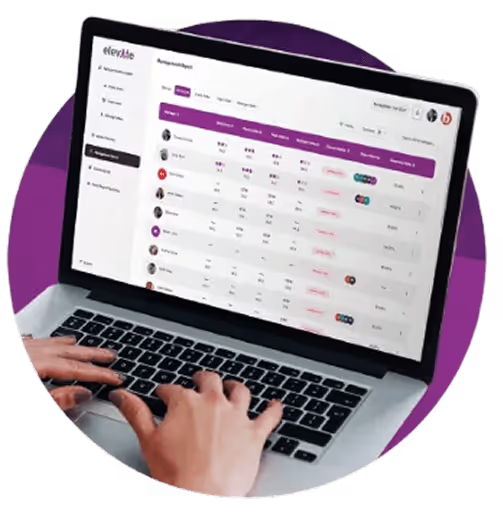
Enter Elevate - our unique platform that transforms accidental managers into intentional coaches. Elevate delivers:
As our CEO puts it:
“Leadership is a journey. Elevate makes that journey possible by turning insight into action and helping managers lead with clarity.”
Elevate doesn’t just train managers - it transforms them. And when your people leaders thrive, your people strategy succeeds.
“Since moving onto Elevate, the insight from our last two surveys has become significantly more valuable. The platform signposts exactly where our managers personally need to focus and provides the clarity and coaching prompts to take meaningful action.
With all our 'People Leaders' now using Elevate, we’ve seen a real shift in focus and accountability. They are more confident in understanding their team’s engagement drivers, clearer on their priorities and better equipped to support our cultural shift and refreshed company values.
The quality of insight has played a key role in our progress, culminating in achieving 2-Star accreditation and seeing a 2% increase in our My Manager and Leadership scores in less than a year. Elevate has quickly become an essential tool in helping us build a stronger, more engaged business.”
Richard Syree - Head of HR
City West Country
Join the movement. Explore how Elevate can help you close the people leadership gap and unlock the full potential of your people strategy.
1 CIPP
3 CAW
4 CMI
5 CMI
6 CMI
7 CMI
8 Author- Kim Scott - https://www.radicalcandor.com/
9 Gallup
10 Deloitte
11 CMI