
.avif)
Four HR Priorities Every C-Suite Leader Must Act On in 2026
The festive period has been and gone, the new year is upon us, and HR leaders up and down the country are putting into action their strategies for 2026.
And this year, possibly more so than any other, it is imperative that HR teams have a sound strategy.
According to Gartner’s 2026 Top HR Trends and CHRO Priorities research, Chief HR Officers are navigating a world where AI is being used to support and facilitate more tasks than ever. For C-suite leaders, these changes are strategic imperatives that will define organisational resilience and growth.
But, what are the key challenges facing HR Officers in the coming year?

Priority 1: Integrating AI to transform HR strategies
AI is undoubtably the hottest topic at the moment. Most organisations have embraced this rapidly evolving technology, and Gartner predicts productivity gains of up to 29% for organisations that integrate AI into their HR operating models.
However, this is only going to be possible if employees understand the capabilities of AI and are trained in how to effectively integrate it into their daily workload. Despite this, only 12% of employees have received training in how to utilise AI to transform the way they work.
Furthermore, our data shows that how employees feel about their training and growth opportunities is declining. Half of all surveyed companies saw their Personal Growth scores decline by an average of -3.06% over the past year.
What this means for leaders:
- Investing in an HR innovation command centre to lead reinvention and employee training is imperative.
- Move toward digital HR solutions where AI handles Tier 0 and Tier 1 activities, freeing human capacity for high-value work.
- Shift HR Business Partners into strategic talent leaders, as AI agents take over repetitive tasks.
This isn’t about replacing people, it’s about augmenting human capability with AI-driven insights and personalisation.
Priority 2: Adapting to the Human-Machine work environment
The AI revolution may not be about replacing people, however there is no escaping that the workforce is no longer just human. As such, leaders need to prepare for a blended workforce, where humans and AI deliver results together.
To achieve this, Chief HR Officers need to:
- Create a talent plan that hires/trains people for both immediate needs and future company change.
- Plan for AI-first design scenarios, where fewer workers manage AI-driven tasks.
- Establish dual KPIs - one for short-term performance, another for strategic outcomes.
This change demands clarity and courage. Without it, organisations risk losing credibility and competitive advantage.

Priority 3: Leading through change
Talking of change, this is something that many individuals struggle with, however, in the modern workplace, change is no longer infrequent, it’s constant.
Furthermore, organisations need to be proactive and plan for change, else they risk poor adoption of any reactive strategies. Data shows that this is a key area that companies need to focus on. The statement “This organisation feels more reactive than proactive” was the third lowest scoring over the past year, highlighting the fact that employees feel that their organisations are not doing enough to prepare for foreseeable challenges.
As such, Chief HR Officers must:
- Reset leadership expectations and embed change reflexes into daily work.
- Equip leaders with tools to manage emotional responses and drive action intuitively.
According to Gartner leader that can turn change into a routine, normalised practice will find that their people are three-times more likely to adopt and thrive under these circumstances.

Priority 4: Creating a culture that powers performance
Normalising change begins with the culture that an organisation creates. Organisations that integrate culture into every aspect of their people's work processes can experience increases of up to 34% in employee performance reported Gartner.
Leaders and HR Officers need to:
- Translate values into actionable behaviours.
- Integrate culture into talent and business processes for consistency.
- Benchmark progress and employee engagement using tools like the Best Companies survey.
Culture is the invisible engine of performance, and it needs deliberate, regular maintenance.
The most effective way to nurture a culture that drives productivity, performance and success, is ensuring that all managers and leaders in the organisation are accountable for its creation.
By utilising Best Companies’ insight platforms, organisations can support managers to cultivate culture and be proactive in planning for change. These are the key priorities than HR teams and companies must be preparing for in 2026.

Turning Insight into Action
At Best Companies, we see these priorities reflected in our own engagement data. While our surveys don’t directly ask employees how they feel about AI, they measure organisational health across eight proven factors. This insight, combined with Elevate, our next-generation performance management platform, enables organisations to empower people managers with AI-driven coaching and personalised development.
Elevate further supports managers to understand how their teams feel about organisational clarity and culture, and their growth and training opportunities, enabling managers to quickly act on any shortfalls and ensure their teams are prepared for the changes needed to bring organisational success in 2026.
What makes Elevate different?
Data-driven leadership development: Managers receive actionable insights from engagement data to improve team alignment and performance.
Personalised dashboards and AI goal-setting: Elevate uses AI to create tailored action plans, ensuring managers focus on what matters most.
Scalable, personalised coaching: Ideal for both experienced and emerging leaders, Elevate combines curated resources with direct feedback loops.
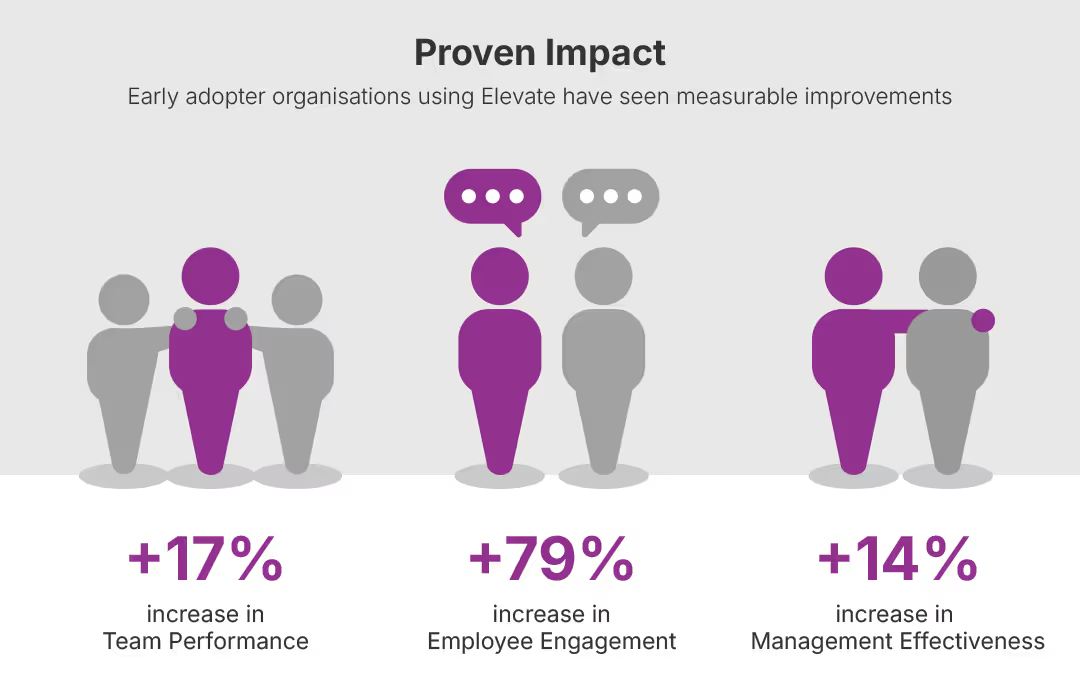
Strategic insights for senior leadership: Identify trends, recognise top managers, and drive decisions that strengthen culture and performance.
The result? A future-ready workforce where technology amplifies human potential, and leaders have the clarity to act decisively.
