When we sit down with people leaders during data insight sessions, we often ask a question that seems simple but opens the door to something profound: ‘What gives your people energy - and what drains it?’
The answers are never unique to any one organisation; they reveal universal truths about what makes work meaningful and what quietly erodes it. Leaders speak about the drivers that energise teams: belonging, innovation, a clear vision, moments of celebration. They also name the things that stifle energy: negativity, unclear boundaries, the relentless pace that leaves no time to think and decisions made behind closed doors.
Why does this matter?
Because these conversations uncover the heartbeat of organisational culture. They remind us that Employee Engagement isn’t a metric, it’s the lived experience of people, shaped by the actions of the organisation.
When we listen deeply and act on what we hear by implementing solutions with employee input, we move beyond ‘culture as a concept’ to culture as a lived reality. The organisations that pay attention to these signs don’t just create happier workplaces, they build resilience, Organisational Clarity and momentum. And that starts with asking the right questions and being brave enough to respond.

The Issue: The High Cost of the "Energy Gap"
Despite years of focus on corporate culture, global engagement remains low. Currently, only 21% of employees worldwide report feeling engaged at work. This isn't just a HR problem, it’s a massive financial issue. Disengagement costs the global economy hundreds of billions in lost productivity annually1.
Our own data at Best Companies reflects this reality: overall engagement scores have declined for the third consecutive year. When teams lack energy drivers like belonging, clarity and recognition, the business feels the impact:
- Lower Productivity: Disengaged teams see an 18% drop in output.
- Higher Absenteeism: Unmet energy needs lead to 81% more missed days.
- Reduced Profitability: Companies with low engagement see 23% less profit than their high-energy peers2.
How to Measure It: The Engagement Equation
To bridge this gap, leadership must move past ‘satisfaction’ (which measures compliance) and start measuring ‘energy’ (which drives commitment).
We simplify this through the Engagement Equation:
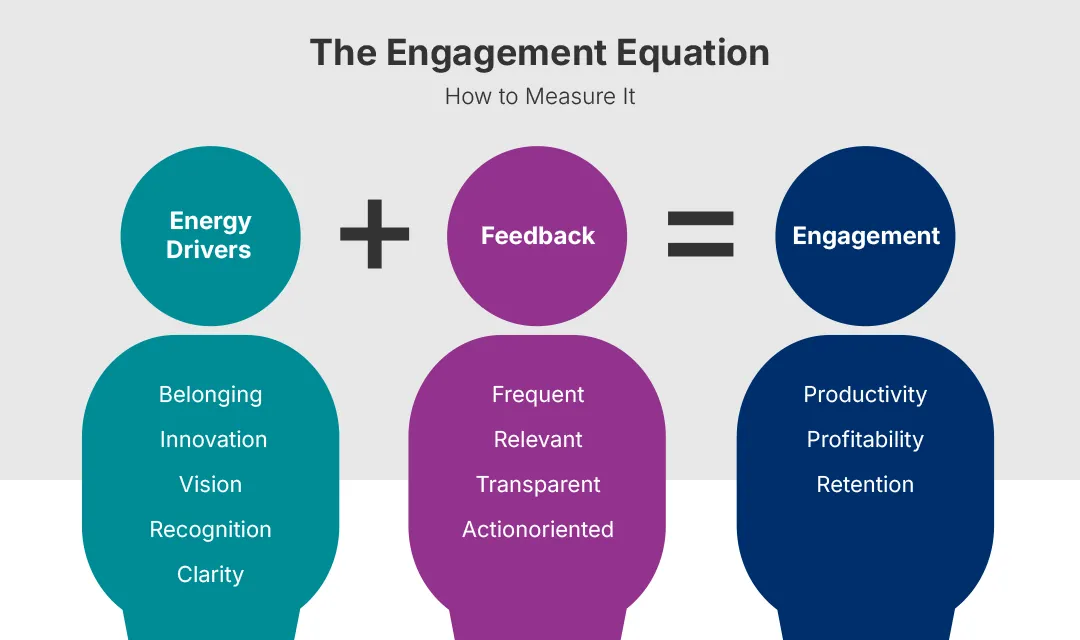
To get an accurate measurement, we analyse responses to the b-Heard survey through the Best Companies 8-Factor Methodology. This evidence-based framework allows you to diagnose energy levels across eight critical dimensions: My Team, Leadership, My Manager, Personal Growth, My Company, Wellbeing, Personal Growth, Fair Deal and Giving Something Back.
The Strategy: 4 Steps to Energise Your People
1. Design Surveys Around Drivers
We don’t just ask if people are ‘happy’. We ask questions that target specific energy drivers:
- Belonging: "I feel a strong sense of family in my team"
- Clarity: " The leader of this organisation runs this organisation based on sound moral principles"
- Innovation: " This job is good for my own personal growth"
2. Diagnose and Neutralise Drains
Use short, targeted pulse surveys to identify hotspots like negativity, infrastructure pain or unclear boundaries.
It is vital that feedback from pulse surveys are acted upon. Nothing kills trust faster than asking for feedback and doing nothing with it. Every pulse must be tied to a visible action plan.
3. Empower Managers as Multipliers
Up to 80% of engagement variance sits with the direct line manager. A people strategy only succeeds if managers are equipped to coach, set boundaries and action survey results at the local team level.
4. Close the Loop Publicly
To build a culture of commitment, you must demonstrate that feedback has power. After every survey:
- Share: Disclose the top 3 drivers and top 3 drains.
- Commit: Discuss potential solutions with your people and assign owners and dates to 3 specific actions.
- Report: Give a progress update within 30 days.
The Payoff
When you stop treating engagement as a concept and start treating it as a designed experience, the results are quantifiable. Engaged organisations see 18% greater productivity and 23% higher profitability.
By focusing on what truly gives your people energy, your strategy stops being theoretical and starts driving the bottom line.