
The debate surrounding return-to-office mandates, remote arrangements and flexible working models has moved from boardroom discussions to concrete workforce metrics. As organisations reassess their operational strategies, a fundamental question persists: How do we build a sustainable workforce strategy that balances retention, culture and business growth?
Looking closely at key performance data across work environments from organisations that completed a Best Companies b-Heard survey (Remote, Hybrid and Office-based), the numbers reveal a clear narrative: moving away from rigid in-office requirements delivers immediate retention gains, but the hybrid model represents the pragmatic, long-term sweet spot for modern organisations.
Hybrid and Remote Working: The Impact on Retention
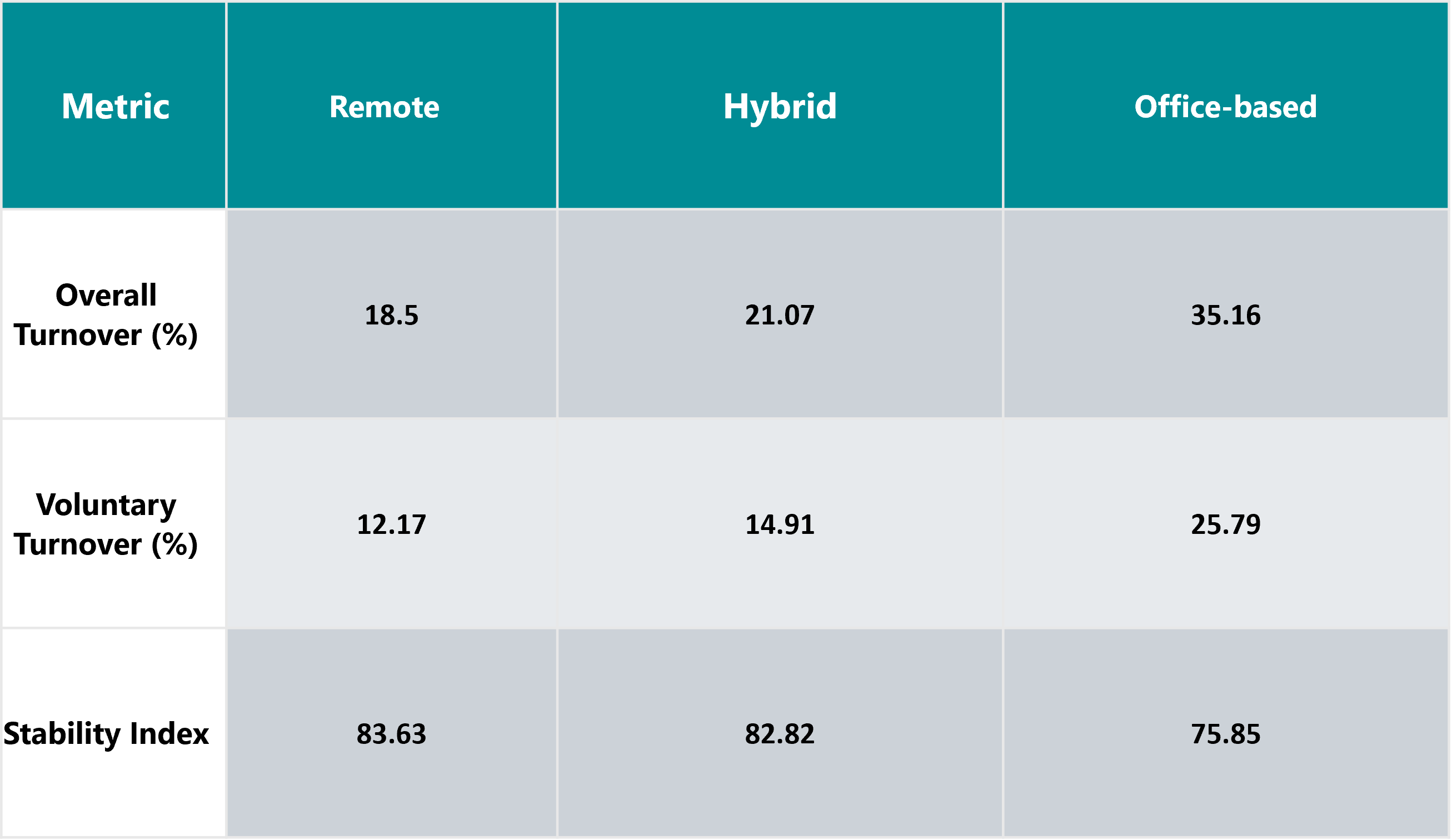
When evaluating organisational stability, turnover rate is the most vital health indicator. Our data reveals a dramatic performance gap between traditional in-office environments and flexible working models:
- Overall Turnover: In-office models experience a high turnover rate of 35.16%. Introducing a hybrid model decreases this figure to 21.07%, capturing the vast majority of turnover reduction. By comparison, moving to a fully remote setup yields only a marginal additional drop to 18.50%.
- Voluntary Turnover: Employees actively choosing to leave their positions follow a near-identical pattern. Office-based environments report a voluntary turnover rate of 25.79%, which drops significantly to 14.91% under a hybrid model and 12.17% in remote setups.
- Stability Index: Reflecting employee longevity, the Stability Index rises sharply from 75.85 in office setups to 82.82 in hybrid models, nearly matching the 83.63 score of fully remote operations.
Key Takeaway: The "Office vs. Remote" Binary is Broken
The biggest structural improvement in workforce stability does not happen when going fully remote, it happens when transitioning from rigid in-office mandates to a flexible Hybrid model. Hybrid working unlocks approximately 85% of the total retention benefit available from flexibility without requiring companies to give up physical presence entirely.
Contextualising the Data
Our b-Heard survey data reports fully remote metrics score slightly higher across certain sentiment indicators, such as My Manager (82.11) or Wellbeing (75.43), it is vital to understand the context behind these figures before drawing broad operational conclusions.
Companies that operate on a fully remote basis are typically highly mature, digitally native organisations that have spent years refining independent communication, specialised tooling and remote-first onboarding. Comparing these specialised, niche remote operations to broader, multi-faceted businesses is not an apples-to-apples comparison.
For the majority of organisations, attempting to force a fully remote setup can introduce operational friction. Hybrid working acts as the realistic bridge, granting employees the day-to-day autonomy they desire while allowing the business to maintain essential operational anchors.
Putting it simply, organisations that understand and respond to employee needs create stronger employee experiences.

The Hidden Long-Term Risks of Remote Working
While survey-based sentiment metrics capture immediate employee satisfaction, they often fail to measure the long-term, systemic risks associated with fully remote environments. Over extended periods, complete remote isolation presents distinct organisational challenges that a Hybrid model intentionally protects against:
- Erosion of Mentorship and Junior Growth: Early-career professionals and new hires benefit exponentially from passive learning, side-by-side coaching and spontaneous observation, elements that are nearly impossible to replicate over video calls.
- Siloed Innovation: While task-based execution remains high in remote setups, cross-functional innovation and breakthrough ideas often depend on casual, unscheduled in-person interactions.
- Weakening Organisational Cohesion: In-person connection fosters deep trust and shared culture that keeps employees aligned with company vision during difficult business cycles.
The Hybrid Advantage: The Best of Both Worlds
To build a resilient workforce strategy, business leaders do not need to choose between total presence and total isolation. Hybrid working provides the exact equilibrium modern employees need:
- Autonomy Without Isolation: By reducing overall turnover from 35.16% down to 21.07%, Hybrid provides employees with the schedule control and commute relief needed to maintain high wellbeing, while retaining a physical anchor.
- Preserving Human Connection: Hybrid ensures that teams still gather periodically for critical strategic alignment, creative brainstorming, and culture-building events.
- Balanced Organisational Stability: Achieving a 82.82 Stability Index, Hybrid gives companies the retention benefits of modern flexibility while safeguarding long-term culture, mentorship and spontaneous innovation.
The Real Question Leaders Should Be Asking
Too often, organisations focus on whether remote, hybrid or office-based working is the "right" model.
A more valuable question is ‘Do we understand how our people feel about the way we work?’
The answer will vary from organisation to organisation.
A technology company may thrive with a remote-first approach. A manufacturing business may require significant on-site presence. Professional services firms may find the greatest value in a carefully balanced hybrid model.
What matters most is understanding how employees experience that reality.
Without employee insight, leaders are left making assumptions.
With employee insight, organisations can identify the specific factors affecting engagement, retention and performance, then take targeted action to address them.

Why Listening Matters More Than Location
The strongest message from our data is not that businesses should abandon the office or enforce remote work.
It's that employee experience should guide workplace strategy.
Organisations that consistently measure engagement gain a clearer understanding of what drives satisfaction, commitment and retention within their own workforce. They can identify whether issues stem from leadership, communication, wellbeing, career development, workload or culture and take action based on evidence rather than opinion.
In today's working world, there is no universal blueprint for success.
The organisations that outperform their peers are not necessarily those that are remote, hybrid or office-based.
They are the organisations that listen to their people, understand what matters most to them and build a workplace experience that supports both business performance and employee wellbeing.
Finding the Right Balance
Our data proves that rigid, strictly in-office arrangements are no longer viable for retaining top talent. However, fully remote setups introduce long-term risks to mentorship, spontaneous collaboration and cultural alignment.
By capturing the vast majority of retention and stability gains while preserving the undeniable power of real-world human connection, Hybrid working stands out as the optimal, balanced model for sustainable organisational success.