
Measuring employee engagement goes far beyond simple job satisfaction; it evaluates how emotionally invested, motivated and aligned your people are with your organisation's goals. For HR specialists, tracking this metric is vital to improving retention, driving organisational performance and building an authentic employer brand. In this guide, we break down how to measure employee engagement effectively using proven survey methodologies, scientific frameworks like Best Companies and actionable strategy.
Why Measure Employee Engagement?
Before implementing a measurement strategy, HR leaders must understand the strategic business value of tracking engagement. Modern engagement programmes offer clear ROI across several key business drivers:
- Predictive Turnover Insights: Disengaged employees are far more likely to leave. Tracking sentiment allows HR teams to identify flight risks and intervene before talent loss impacts operations.
- Enhanced Organisational Health: High engagement directly correlates with lower absenteeism, stronger psychological safety and improved day-to-day team productivity.
- Clearer ROI on HR Initiatives: Measuring engagement gives HR specialists baseline data to evaluate whether leadership training, wellness perks or career development programmes are actually yielding results.
Measurable Financial Impact & ROI
Beyond cultural and operational benefits, measuring how employees feel provides clear evidence of the ROI of employee engagement across the entire business. Companies with highly engaged workforces consistently report higher productivity, stronger customer retention and superior profit margins. By tying survey metrics directly to commercial outcomes, such as lower turnover costs and increased revenue per employee, HR leaders can demonstrate how strategic engagement initiatives deliver tangible financial returns. For real-world examples, explore these to see how organisations maximise their return on engagement.

Survey Methodologies: Beyond the Annual Questionnaire
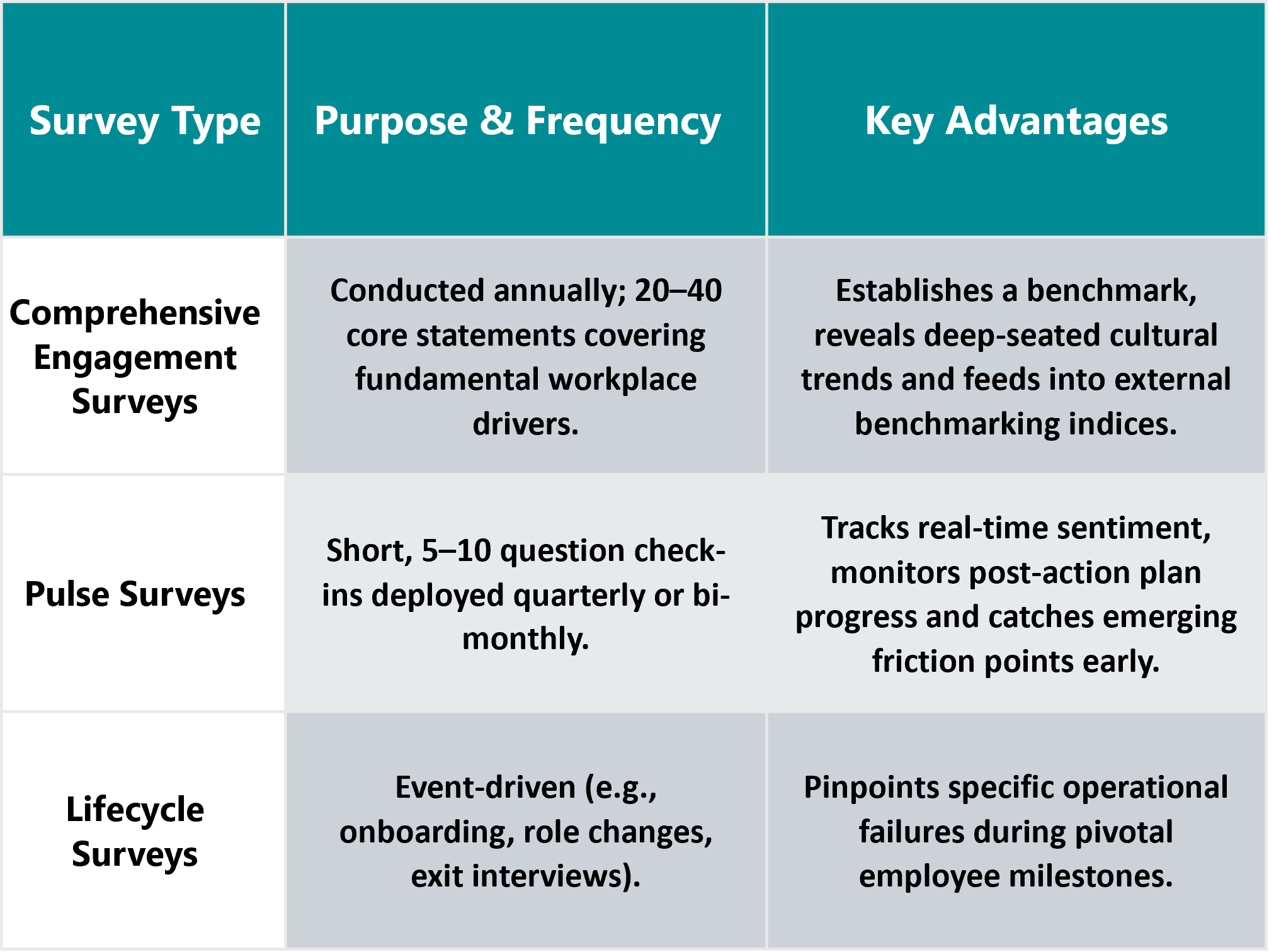
Surveys remain the most effective tool for gathering structured employee sentiment. However, the modern listening strategy has evolved past static, once-a-year questionnaires. To capture an accurate picture, HR teams should leverage a multi-tiered continuous listening approach:
How to Measure Employee Engagement Using Best Companies & The 8-Factor Model
To gain meaningful insights, survey data must be grounded in academically validated research rather than generic questionnaires. A leading benchmark in employee engagement methodology is the Best Companies 8-Factor Model. Developed in partnership with academic experts, this framework measures the full spectrum of the lived employee experience across eight intercorrelated factors:
- My Team: Assesses peer relationships, cohesion and sense of belonging within immediate working groups.
- Leadership: Evaluates how employees view senior management, the company's direction and organisational values.
- My Manager: Measures the immediate relationship between employees and managers, focusing on trust, support and coaching.
- Personal Growth: Tracks opportunities for learning, challenge, skill utilisation and career advancement.
- My Company: Captures pride, alignment with corporate objectives and how much employees value the organisation.
- Wellbeing: Measures work-life balance, stress and pressure management to protect mental and physical health.
- Fair Deal: Assesses perceptions of pay, benefits and overall recognition relative to market standards.
- Giving Something Back: Measures how staff view the company’s social responsibility and community impact.
Using Likert-scale statements across the 8-Factors allows HR leaders to calculate a precise index score (Best Companies Index - BCI), highlighting heatmaps of high performance and root-cause underperformance across teams.

Best Practices for Survey Implementation
Gathering accurate feedback requires a secure, clear survey design. When planning how to measure employee engagement internally, apply these core rules:
- Ensure Strict Anonymity: Employees must trust that their answers will not lead to personal backlash. Use third-party providers or aggregated reporting thresholds (e.g., minimum 5 respondents per team) to safeguard privacy.
- Combine Quantitative and Qualitative Data: Pair 7-point Likert scale statements with open-ended prompts. Quantitative data shows what is happening, while qualitative text uncovers why.
- Act on Feedback Promptly: Survey fatigue occurs when employees feel their input vanishes into a black hole. Share anonymised heatmaps with line managers within weeks of closing the survey, co-creating targeted micro-actions with teams.
Ultimately, measuring employee engagement is not a standalone HR exercise or a passive data-collection campaign, it is an active operational strategy. By combining robust frameworks like the 8-Factor Model with agile listening strategies, HR leaders gain the clarity needed to make data-informed decisions, improve retention and foster an environment where employees can genuinely thrive.