
State of Engagement 2026 Report |
Download report



The Leader will let staff know at the earliest opportunity about issues that may affect the college moving forward and which could potentially affect their jobs. Although they are facing budgetary restraints she has ensured that staff have received a non-consolidated bonus as recognition for their contribution, while we cannot afford a pay rise generally applied to wages. She has involved all staff in their recent Ofsted Inspection success and ensured they were all equally recognised for their support.
The College employed an in-house management development consultant for two years to support managers, SMT and some team development. Managers identify support networks to join in and the College is a member of a college peer review group and support each other in the group. HR provides regular in house training on policies and managers' role in them.
There is a staff Christmas party and Oscar ceremony with part employee contribution and summer staff barbeque also part contribution.


Effective Talent Management and Leadership Development is a key objective for Chief Executives, Chairs and Boards. Best Practice research suggests that there are eight pre-conditions or essentials for successful Talent Management and Leadership Development. The NHS East of England propose that these essentials are simplified and embedded into the SHA and PCT Talent and Leadership plans to provide a consistent and coherent focus of attention, ensuring that they are spoilt for choice for Leaders and Talent across the NHS both now and in the future.
The NHS East of England are a high performing organisation that makes many exciting demands of their staff. They offer a vibrant, dynamic working environment that gives opportunities for people to explore both breadth and depth in their roles. While the pace is fast and the expectations are high, they give back to their staff as much as they give to the organisation.
The NHS East of England are a high performing organisation that makes many exciting demands of their staff. They offer a vibrant, dynamic working environment that gives opportunities for people to explore both breadth and depth in their roles. While the pace is fast and the expectations are high, they give back to their staff as much as they give to the organisation.

There is pay/support for external management qualifications via application for further studies, Annual performance review, with development targets and resources aligned to outcome is in place. There is internal coaching/mentoring for all new starters,Teachers within ITT programme and newly qualified teachers are supported by specialist mentors. Capability and performance indicators are assigned for specialist mentoring/coaching support, dependent upon topic. Specialist network memberships are available e.g. teacher educator forums, strategic local partnerships to encourage engagement with the local community.
On average employees receive fifteen hours formal training each year, with an average spend of £250.75 per year per employee. examples of the sorts of training activities available are as follows: Safeguarding Children Training (Foundation, Level 1 and level 2) Equality & Diversity (Training and Qualifications) Awareness of special learning and other needs of students – e.g. autistic spectrum awareness, dyslexia awareness, visual impairment awareness, mental health awareness training E-Learning – innovative use of modern technologies to encourage personalised learning – e.g. podcasting on mobile phones, on-line teaching and learning, how to use blogs Management Techniques – e.g. performance review training, grievance & discipline training ICT – e.g. MS Office, in-house data management systems Finance and budgetary control Risk assessments Pastoral Tutoring training Setting SMART Targets.
There is pay/support for external management qualifications via application for further studies, Annual performance review, with development targets and resources aligned to outcome is in place. There is internal coaching/mentoring for all new starters,Teachers within ITT programme and newly qualified teachers are supported by specialist mentors. Capability and performance indicators are assigned for specialist mentoring/coaching support, dependent upon topic. Specialist network memberships are available e.g. teacher educator forums, strategic local partnerships to encourage engagement with the local community.

Training activities within the organisation include Pensions Scheme training, Data Protection, IT Systems and Corporate training. Formal qualifications are also supported through time off or funds.
In order to support people managers in the organisation, they have Internal management development training, meetings and internal/external coaching available.
Training activities within the organisation include Pensions Scheme training, Data Protection, IT Systems and Corporate training. Formal qualifications are also supported through time off or funds.
On average employees receive sixty hours of formal training a year and have included teacher training, Masters, Professional Qualifications, stress awareness, operational and NVQ's. Formal qualifications are supported either through time off, funding or other resources roughly four hours remission per week is given and one day per week to attend college.
Team celebrations and events are run by the manager of that Unit or School. Employees undergo formal team building. This happens on average once a year and is driven by individual managers.
Team celebrations and events are run by the manager of that Unit or School. Employees undergo formal team building. This happens on average once a year and is driven by individual managers.
Instant recognition is provided in the form of cards and personal notes from managers and senior managers. Internal communication is provided through 'Principal's Briefings' sent via e-mail to all staff. Full staff meetings, team meetings and briefings are also provided to communicate with staff. They also conduct other surveys including Investors in People, Customer Service Excellence (formerly Chartermark) and whilst these are not 'formally' Employee Engagement Surveys, they give the College a snapshot of staff views and give staff an opportunity to explain their feelings about the College.
On average employees receive twenty hours formal training per year including Teacher training, Assessor and Verifer Awards, First Aid at Work, Manual Handling, Health & Safety, a variety of IT training, Active Listening Skills, attendance at numerous internal and external conferences and seminars, Autism Awareness Sessions, Child Protection Training, Subject-specific update, legislative and professional courses ie British Canoe Union training, BSc in Information & Library Studies, Rabbit Welfare training.
The organisation has a budget specifically for fun and social events and have included the annual staff Christmas Party. The College provide wine and mince pies at the end of the Autumn Term to get employees in the Christmas spirit for the holidays. Employees have formal team building 3 – 5 times a year, 3 times per year for Academic staff as part of course reviews, less so for support staff. Management teams have 'away days' and teams undertake informal team-building activities.

The leader/senior management interact with employees on a day to day basis in and around Head Office. They visit schemes, there are meetings which more junior staff attend and there are regular staff briefings. The Leader puts clients at the forefront of leadership, decision making and strategic developments and champions marginalised groups.
Management tool kits/resources give access to training, checklists and induction and support from colleagues. There is pay/support for external management qualifications. Typically ILM, CMS,DMS and MBA courses have been supported. Also there is training in Health and Social Care. There is access to individually identified training i.e. ILM or in-house Managers Toolkit Training. Other Seminars/managers forums or other peer support opportunities are meetings for Heads of Service, specific meetings for housing managers and floating support managers.
Management tool kits/resources give access to training, checklists and induction and support from colleagues. There is pay/support for external management qualifications. Typically ILM, CMS,DMS and MBA courses have been supported. Also there is training in Health and Social Care. There is access to individually identified training i.e. ILM or in-house Managers Toolkit Training. Other Seminars/managers forums or other peer support opportunities are meetings for Heads of Service, specific meetings for housing managers and floating support managers.

Every year, employees are given the opportunity to nominate a charity for any monies raised to be donated to. The Social Committee is responsible for choosing 3 or 4 causes which the money raised throughout the year is divided between. Fundraising events go on within different offices throughout the year. Local offices regularly hold dress down days, bacon roll mornings, book sales, Burns lunches and lots more. Employees are allowed to participate in these activities during work hours in order to raise as much money as possible.
Over the last 26 years John Mulloy has been instrumental in delivering award winning developments, top class service and innovative initiatives. Under John's leadership Hillcrest Housing Association has evolved from solely being a housing provider to being the parent company of a group of companies providing housing, care and wider role activities. It is John's determination to move the Group on and embrace the best new ideas and initiatives that make his leadership skills distinct. The Group is never standing still and is always exploring new ideas, projects and ways of working. This makes it exciting for employees to be part of the Group. Everyday is never the same for a lot of people within the Group.
Every year, employees are given the opportunity to nominate a charity for any monies raised to be donated to. The Social Committee is responsible for choosing 3 or 4 causes which the money raised throughout the year is divided between. Fundraising events go on within different offices throughout the year. Local offices regularly hold dress down days, bacon roll mornings, book sales, Burns lunches and lots more. Employees are allowed to participate in these activities during work hours in order to raise as much money as possible.

Fenland District Council has a Health Improvement Co-Ordinator. They hold well being events and there are leisure services that employees can use.
Fenland District Council has a Health Improvement Co-Ordinator. They hold well being events and there are leisure services that employees can use.
Fenland District Council has a Health Improvement Co-Ordinator. They hold well being events and there are leisure services that employees can use.
You’ve explored the Factors - now discover how your organisation can gain deeper insight into what truly drives engagement and workplace culture.
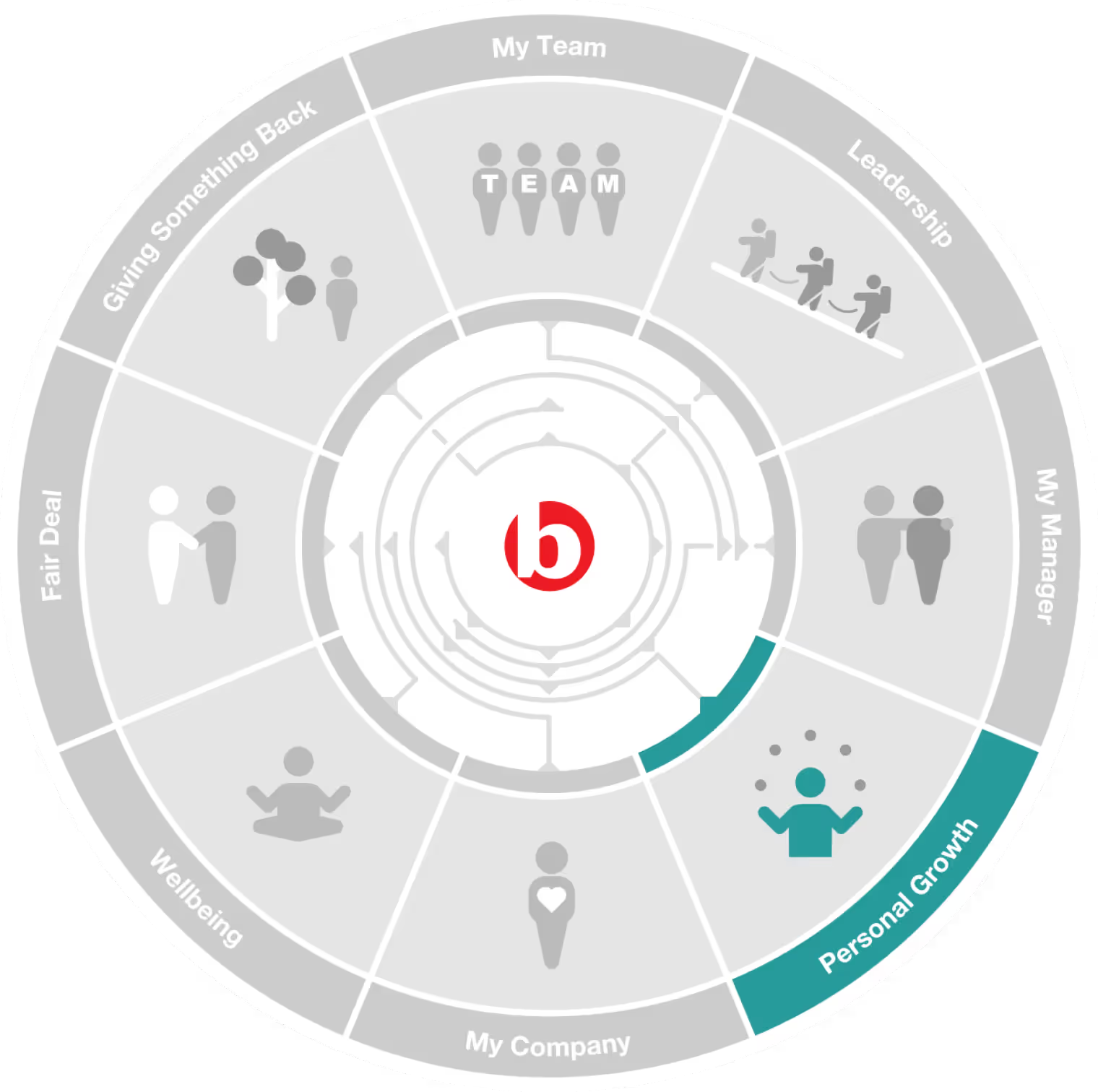
Our approach measures organisational health across eight core areas: My Team, Leadership, My Manager, Personal Growth, My Company, Wellbeing, Fair Deal, and Giving Something Back. Together, they give you a complete view of how your people think, feel, and experience work.
Complete the form and take the first step toward a stronger, more engaged organisation.