
For HR specialists, designing an effective feedback loop is vital for employee retention, driving performance and cultivating a healthy work environment. Yet, whenever a new engagement survey is launched, one lingering question routinely stalls participation: Are employee surveys really anonymous?
According to industry data, nearly half of all employees believe their survey responses can be traced back to them. This scepticism directly impacts your response rate and skews your data, as staff withhold candid feedback or default to "safe" answers out of fear of reprisal.
The short answer? Internal DIY forms often fall short, but professional third-party providers use sophisticated safeguards to ensure total privacy. Here is how independent platform architecture protects identity and builds lasting trust.
The Vital Difference: Anonymous vs. Confidential Surveys
Before evaluating technical safeguards, HR professionals must distinguish between two core survey structures:
- Anonymous Surveys: No identifying data (such as IP addresses, names or employee IDs) is collected or stored at any point. The system has zero record of who submitted the response.
- Confidential Surveys: Demographic data (e.g., department, tenure) is linked to responses on the back end to allow deep segmentation. However, strict firewalling prevents anyone within your organisation from matching those attributes to an individual.
Understanding this distinction allows HR teams to select the right approach while setting clear expectations with their workforce.

How Third-Party Providers Protect Survey Anonymity
When organisations rely on internal tools like standard spreadsheets or basic internal forms, employees are rightfully suspicious. Internal HR admins often have direct access to submission metadata, timestamps and network logs.
Specialised third-party platforms eliminate this risk through robust, platform-level safeguards:
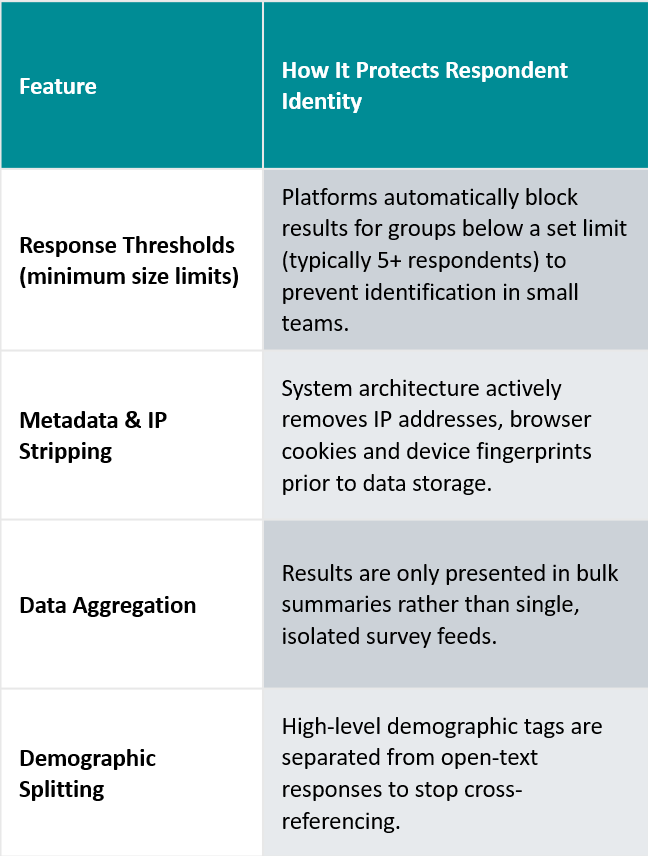
Leading organisations prioritise these exact measures to give employees complete confidence. You can read more about these protective measures on How We Keep Feedback Anonymous at Best Companies.

Are Employee Surveys Really Anonymous When Using Open-Text Comments?
The most common point of failure in feedback confidentiality isn't technical, it is human error in open-ended text fields. Employees frequently write about specific projects, mention unique team dynamics or use distinct phrasing that reveals their identity.
Third-party survey administrators mitigate this through specific protocols:
- Pre-Survey Guidance: Prompts dynamically warn respondents not to include names, hyper-specific project references or self-identifying details in comment fields.
- Randomised Comment Order: Open-ended comments are decoupled from numerical scoring and presented in randomised lists so managers cannot cross-reference a low score with a specific comment style.
The Risks of DIY Internal Surveys
Attempting to run sensitive employee feedback campaigns in-house using basic internal tools presents significant hurdles for HR specialists:
- Accidental Tracking: Systems like basic web forms often record email addresses or network IDs by default.
- Lack of Reporting Firewalls: Without automated response thresholds, line managers over small teams can easily deduce who left specific feedback.
- Erosion of Trust: If staff suspect their responses aren't secure, participation drops and feedback becomes filtered, rendering the survey data unusable.
Best Practices for HR: Communicating Anonymity to Staff
Deploying a secure third-party tool is only half the battle; HR must also effectively communicate these protections to build organisational trust:
- Publish a Clear Confidentiality Statement: Include an explicit pledge on the survey landing page detailing how data is processed, stored and aggregated.
- Highlight Third-Party Separation: Emphasise that an external partner manages the database and that internal managers will never have access to raw response feeds.
- Share Aggregated Results Openly: Demonstrate transparency by presenting company-wide trends and outlining the concrete action plans taking place based on the feedback.
When HR teams pair third-party platform safeguards with clear communication, the question shifts from "Are employee surveys really anonymous?" to "How can we best use this honest data to drive positive change?" By securing feedback channels, you empower your workforce to speak candidly, giving your leadership team the accurate insights needed to build a stronger work environment.