
An employee engagement survey can show you where people are thriving and where their experience needs attention, making employee engagement action plan examples a helpful starting point for turning those insights into concrete steps. But a result on its own cannot tell you everything about why people feel that way, or what will make the greatest difference.
That is where action planning begins. By sharing the findings, asking employees what sits behind them and agreeing on practical next steps, organisations can turn feedback into improvement that people can see and shape.
The five ideas below offer practical inspiration. Just remember, the most effective plan will depend on what your own people tell you.
Why does employee engagement need an action plan?
Measuring engagement helps you spot patterns that might otherwise be missed. A company-wide result can reveal a broad challenge, while a closer look at teams can show that people experience the same workplace very differently.
The challenge is deciding what to do with that information. Leaders may feel pressure to respond to every result at once, managers may be unsure how to discuss difficult feedback and employees may wonder whether sharing their views will lead to anything changing.
Historically, many organisations relied on a traditional "You said, we did" framework, where leaders took action on feedback in isolation. Today, this model has evolved into "You said, we listened and together we improved", shifting the focus from passive listening to collaborative action and shared ownership.
An action plan creates a way forward and it gives people a chance to understand the results together, decide what matters most and see who will take each step. Ultimately, it ensures that improving employee experience becomes a collective effort rather than a one-sided management responsibility.

Leadership action planning and team action planning: what is the difference?
Some issues need decisions across the organisation. Others are best understood and addressed by the people who work together every day.
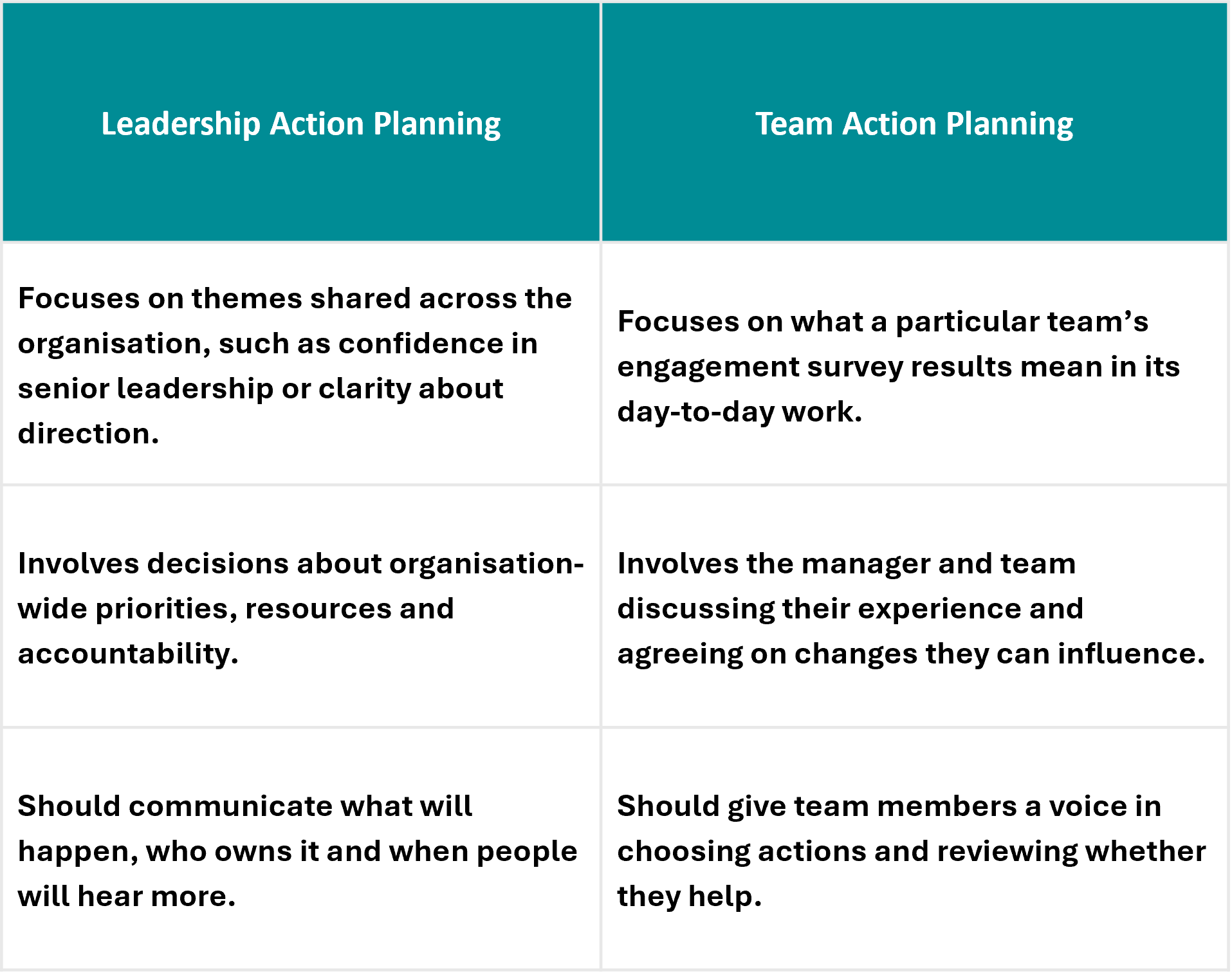
The two need to work together. A team can improve how it shares updates, for example, but it cannot resolve a company-wide lack of clarity about strategy on its own. Equally, an organisation-wide initiative may miss a problem that only shows up in one team’s results.
HR helps make both levels of action planning effective by providing guidance, protecting confidentiality and supporting People Leaders to understand and discuss the results. People Leaders should have the confidence and structure to explore feedback with their teams, while HR and the Executive Team address systemic issues that extend beyond an individual team.
Five employee engagement action plan examples
These examples show how a survey finding could lead to a conversation and then a specific action. They are prompts to explore with employees, rather than fixes to apply without asking what is behind their feedback.
1. Make leadership communication a conversation
What the feedback might show: Employees do not feel listened to by senior leaders or understand the reasons behind decisions.
What to explore: Which decisions need more explanation? Where do employees currently have an opportunity to ask questions or challenge assumptions?
An action to try: Introduce a regular leadership update that explains a recent decision and makes space for questions. Record the questions that cannot be answered immediately, assign an owner and follow up publicly.
How to review it: Ask employees whether the updates have helped them understand decisions and whether they feel able to raise questions.
2. Agree priorities when workloads change
What the feedback might show: People are struggling with workload or finding it hard to balance competing demands.
What to explore: Is the pressure caused by the volume of work, unclear priorities, a process that creates extra effort or a lack of capacity?
An action to try: Hold a short weekly priorities discussion. Agree what must be done, what can wait and what needs support or escalation. If the team identifies a capacity issue it cannot solve, take the evidence to leadership.
How to review it: Check whether priorities are clearer and whether the causes of pressure have changed. A wellbeing initiative may offer support, but it will not remove a workload problem by itself.
3. Make development opportunities clearer
What the feedback might show: Employees are unsure how they can grow or progress.
What to explore: Do people know what skills they need to develop? Can they see opportunities for promotions or career advancement?
An action to try: Ensure time is set aside during 1-2-1’s to discuss development goals with each person, then agree one practical opportunity, such as training, a stretch project or maybe opportunities to learn from another team.
How to review it: Follow up on whether the opportunity happened and whether the employee feels clearer about their next step.
4. Close the loop on employee suggestions
What the feedback might show: Employees are willing to share ideas but do not know what happens to them.
What to explore: How are suggestions collected, considered and answered today? Are people told when an idea cannot be taken forward, and why?
An action to try: Keep a visible record of suggestions and decisions. Share what is being explored, what has changed, and what cannot change at present and why.
How to review it: Ask whether employees can point to examples of feedback being considered and whether the explanation behind decisions feels clear.
5. Learn from a team that is doing well
What the feedback might show: One team scores strongly in an area where another is struggling.
What to explore: What does the stronger team do in practice? Would any of those habits help elsewhere, or are the teams facing different circumstances?
An action to try: Bring the teams together to share approaches. Let the team seeking improvement choose one habit to adapt and test.
How to review it: Ask the team whether the new habit is useful before deciding to continue or expand it.
Keep the plan focused with the 1 + 3 Method™
Action planning can become overwhelming when every result appears to demand a separate initiative. The Best Companies 1 + 3 Method™ gives leaders and teams a simpler starting point: identify one area to celebrate and three opportunities to improve.
Celebrating a strength matters. It helps a team recognise what is already working and consider how to protect it. Focusing on three improvement areas then gives the conversation direction without losing sight of the wider survey results.
The 1 + 3 Method™ sits within our R³ approach: Receive, Reflect and Respond. People Leaders first receive relevant insight with guidance, then reflect on the patterns and questions it raises before involving their team in what happens next. The 1 + 3 Method™ structures that conversation, helping teams celebrate what is working and explore three opportunities to improve together. Agreed actions should have clear owners and review dates, with progress revisited over time.
Explore the 1 + 3 Method™ eBook for a practical framework to help teams turn insight into action.

What does action planning look like in practice?
At ForHousing, action planning connects leadership accountability with employee involvement. Its executive team aligned around engagement as a strategic priority, while individual teams hold workshops to agree actions for their own teams and the wider organisation. A staff forum also helps colleagues share feedback and track progress against the action plan. ForHousing reports a 12% increase in retention and has achieved 2-Star Best Companies Accreditation.
Read the ForHousing client story.
From survey results to visible change
A useful employee engagement action plan should make it easy to answer four questions: What have we heard? What have we agreed to do? Who is responsible? When will we review it?
The actions do not all need to be large. What matters is that they respond to the experience behind the data, involve the people affected and lead to honest updates on progress. That is how measuring engagement becomes a starting point for improving it.
Best Companies connects engagement measurement with insight, People Leadership development and focused improvement. Workplace Insight helps organisations understand their results, while Elevate connects employee insight with guidance, reflection, coaching, action and accountability. Together, these capabilities support People Leaders and their teams to turn feedback into better conversations, agreed commitments and visible progress. Explore how to turn engagement insight into action.