State of Engagement 2026 Report |
Download report




Senior Management frequently recognise success in a variety of ways e.g. through celebration events, awards at weekly staff briefing, letters of thanks, certificates on the college website and intranet.
Employee development is fully supported here. All training directly related to an employees' role is fully funded, including fees and time for external qualifications such as NVQs, professional qualifications, teacher training and other postgraduate courses. There is also a fund to contribute to personal development activities not directly related to job roles.

Hospiscare supports employee development best through its comprehensive Learning and Development Programme. This in-house programme offers 71 separate training opportunities between April 2011 and March 2012. These range from one hour sessions on a ‘hot topic', to essential updates to support staff in their roles, to four day courses on Bereavement and Loss. The programme is needs-led and responsive, with managers and employees regularly being consulted on their learning needs. This programme is also informed through analysis of appraisals and the training needs identified within them. Needs are responded to quickly either by provision of an in-house course if demand is great enough and there is capacity within the organisation, if the need cannot be met in-house an appropriate external course is sought.
Each year staff including the Senior Management Team organise an 'end of year review' in the style of a sketch show, involving as many people as possible. The Senior Management Team provides refreshments at the end for all to enjoy. They have also hosted two weddings for patients which the staff have worked very hard to organise at the last moment. Both weddings were greatly received by all those involved and this lifted the spirits of the staff involved in the organisation as they were able to do that little bit more for the patients and their families.
Hospiscare supports employee development best through its comprehensive Learning and Development Programme. This in-house programme offers 71 separate training opportunities between April 2011 and March 2012. These range from one hour sessions on a ‘hot topic', to essential updates to support staff in their roles, to four day courses on Bereavement and Loss. The programme is needs-led and responsive, with managers and employees regularly being consulted on their learning needs. This programme is also informed through analysis of appraisals and the training needs identified within them. Needs are responded to quickly either by provision of an in-house course if demand is great enough and there is capacity within the organisation, if the need cannot be met in-house an appropriate external course is sought.
Holycross Sixth Form College educate young people in order that they have the opportunity to develop spiritually, morally and intellectually. Holycross have an environmental group comprising staff and students which works in the local community doing conservation work, for example tree planting.
Holycross Sixth Form College educate young people in order that they have the opportunity to develop spiritually, morally and intellectually. Holycross have an environmental group comprising staff and students which works in the local community doing conservation work, for example tree planting.
A particularly memorable event was when they held a Mission and Ethos Day in July 2011 where different activities were organised for staff to take part in. There was for example, a barge trip around Salford, a trip to the Lake District, visits to museums and a day of indoor skiing.
Employee development is fully supported and the Association has become an accredited City and Guilds Centre and has a dedicated Learning and Development Team to ensure that qualifications are offered for most roles within the association. It is also an approved centre for the Institute of Leadership and Management, offering a variety of levels of management qualifications for staff wanting to go into management or improve their management skills.
The organisation is a charitable housing association providing a wide range of housing and support services for the families and single people including those with special needs. They are a well-established provider of support to people with complex needs, both in the community and living in their own supported housing schemes, supporting people with learning difficulties, mental health issues, young people, women and the homeless. Their aim is to provide appropriate support to each person living in their own home to enable them to develop independent living skills, be involved in decisions regarding their life and participate in their local community. They also run charity shops.
The organisation is a charitable housing association providing a wide range of housing and support services for the families and single people including those with special needs. They are a well-established provider of support to people with complex needs, both in the community and living in their own supported housing schemes, supporting people with learning difficulties, mental health issues, young people, women and the homeless. Their aim is to provide appropriate support to each person living in their own home to enable them to develop independent living skills, be involved in decisions regarding their life and participate in their local community. They also run charity shops.

In the last 12 months there has been the formation of a Senior Managers' Group which means there is a core group of managers responsible for key aspects such as managing attendance and working together to support the Leadership Team as well as managers and colleagues within their teams. It enables idea sharing and a cohesive approach to guiding and supporting colleagues across the Trust, as well as an additional forum for sharing ideas and listening and learning from experiences. Nick Atkin the Chief Executive is an exceptional leader who is the driving force behind the performance, direction and success of the organisation. What makes him distinctive is his approach to business, to the customers; to colleagues and to the working environment he has created. In business, he is very driven and extremely determined. He leads by example, is very well respected and strives for excellence and success. He is innovative, encourages new ideas and radical thinking and embraces change. On a personal level, he is extremely personable and supportive, accessible and takes a personal interest in all colleagues.
In the last 12 months there has been the formation of a Senior Managers' Group which means there is a core group of managers responsible for key aspects such as managing attendance and working together to support the Leadership Team as well as managers and colleagues within their teams. It enables idea sharing and a cohesive approach to guiding and supporting colleagues across the Trust, as well as an additional forum for sharing ideas and listening and learning from experiences. Nick Atkin the Chief Executive is an exceptional leader who is the driving force behind the performance, direction and success of the organisation. What makes him distinctive is his approach to business, to the customers; to colleagues and to the working environment he has created. In business, he is very driven and extremely determined. He leads by example, is very well respected and strives for excellence and success. He is innovative, encourages new ideas and radical thinking and embraces change. On a personal level, he is extremely personable and supportive, accessible and takes a personal interest in all colleagues.
New starters and all colleagues have access to the Leadership Team. There is an open door style of support and there are many mechanisms to ensure colleagues feel listened to and their feedback is taken on board. Flexible working ensures and enables an equalitarian style of working which enables both formal and informal messages to be relayed and is a two-way opportunity. Their Performance Screens at each site ensure clarity and consistency of messages, incorporating competitions on the screens, sharing good news as well as updates on the balanced scorecard, health and wellbeing initiatives to ensure a consistent approach to communicating effectively. The monthly brief is an employee briefing which seeks feedback with answers to questions and comments provided the following month. They also have a staff magazine, GRAPEVINE, which includes information and competitions and involves a cross section of colleagues to ensure a mix of attractive articles for everyone.

As an organisation, they have been looking at a holistic approach to Healthy Workplaces and considering what effect health has on work and work has on health. They plan to run a series of educating campaigns around healthy hearts e.g. eating well, smoking cessation, encouraging 5 minute desk workouts etc. and healthy minds e.g. managing stress and anxiety, challenging behaviours, seeking support, etc. Examples of some of the things they already offer to enhance employee wellbeing are flexible working, independent counselling sessions and a cycle to work scheme. There are also healthy options within the Goodwin Café. They recently conducted a Healthy Workplace Survey to find out what improvements staff felt they could make. One of the suggestions included making it known what the ‘points' values of meals served in the Goodwin Cafe are for those participating in Weightwatchers which has been put in place. Other suggested initiatives included pool bicycles to get to meetings and between sites, a fun group dance and sport leagues which are being considered.
As an organisation, they have been looking at a holistic approach to Healthy Workplaces and considering what effect health has on work and work has on health. They plan to run a series of educating campaigns around healthy hearts e.g. eating well, smoking cessation, encouraging 5 minute desk workouts etc. and healthy minds e.g. managing stress and anxiety, challenging behaviours, seeking support, etc. Examples of some of the things they already offer to enhance employee wellbeing are flexible working, independent counselling sessions and a cycle to work scheme. There are also healthy options within the Goodwin Café. They recently conducted a Healthy Workplace Survey to find out what improvements staff felt they could make. One of the suggestions included making it known what the ‘points' values of meals served in the Goodwin Cafe are for those participating in Weightwatchers which has been put in place. Other suggested initiatives included pool bicycles to get to meetings and between sites, a fun group dance and sport leagues which are being considered.
In addition to regular supervisions, all staff have at least two personal development reviews (PDR) with their line manager per year. At these meetings, along with a review and assessment of objectives, their development needs are also discussed. Development can be in the form of formal training, e.g. training courses, attendance at events or conferences or informal training e.g. mentoring, coaching and shadowing. Staff are encouraged to take responsibility for identifying, planning and fulfilling their own learning and development needs through the appraisal process and highlight any training that would be beneficial in their development, whilst meeting their need for job satisfaction and career progression. Possibly the most successful employee development programme is their mentoring scheme. A number of managers have undergone mentoring and coaching training so that they can mentor new managers, but also any staff wishing to develop particular skills or progress into a management role. Mentoring is a learning and development process which allows a mentee to discuss any issues or development needs they have with a more experienced mentor.
The organisation seeks to reward employees for their efforts. The Principal handwrites letters of congratulations on exam performance to all Heads of Department and subject departments in September and follows up with handwritten Christmas Cards to all teams and departments.
They plan to share the outcomes of the survey with staff, celebrate the things that they do well, and address issues of concern summarised in an appropriate action plan. This will form an important part of the Staff development Self-Assessment Report (SAR). The SAR is reviewed and validated every year and a new action plan developed in response to the results of the previous action plan and any developments in education and government policies.
Managers provide tea and coffee at morning break in order to encourage staff into the staff room where they can meet and chat and get away from the pressures of the classroom. They socialise with staff during morning and lunch breaks and have an open door policy. They hold regular departmental meetings and encourage six monthly progress reviews, reviewing training and development opportunities for staff. It is also their job to listen and respond in a timely fashion. Managers are confident in seeking advice from senior managers in more difficult or challenging circumstances. They also lead from the front and promote active consultation, communicating issues which will affect staff.

GHA knows face-to-face communication is the best way to get staff involved. During periods of change or when new initiatives are launching, the Chief Executive Martin Armstrong takes time out to go round local offices having face-to-face meetings with staff. He talks to them in an honest, open and inspirational way, challenging staff to give their views and listening to their feedback. Teamtalk, their internal communications strategy, ensures information is cascaded to every member of staff to facilitate team discussion sessions and staff are encouraged to give feedback to managers. They have a strong culture of listening to feedback from all surveys and external assessments, celebrating successes and putting in place improvement plans to address all issues highlighted. Their journey to deliver excellent services for their customers has been hugely influenced by survey feedback and external assessment. Staff are involved in shaping the improvements they put in place, through their teams and in joint forums.
Winning the Scottish Award for Business Excellence, Scotland's top business award, was a tremendous achievement for GHA in 2011. The Chief Executive was keen to show all staff his recognition of their hard work that made this happen. He wrote to all staff and personally thanked them for their hard work, passion and commitment and he decided to reward staff with an extra day's holiday. His personal address and the extra day off made every member of staff feel their part in the organisation was recognised right from the top.
Winning the Scottish Award for Business Excellence, Scotland's top business award, was a tremendous achievement for GHA in 2011. The Chief Executive was keen to show all staff his recognition of their hard work that made this happen. He wrote to all staff and personally thanked them for their hard work, passion and commitment and he decided to reward staff with an extra day's holiday. His personal address and the extra day off made every member of staff feel their part in the organisation was recognised right from the top.
GHA runs a contribution based pay scheme which is quite unique to the sector in which they operate. This was introduced for the 2010-2011 performance year following an extensive review of their reward strategy practices. The Association's new Reward Strategy aims to pay upper quartile salaries for upper quartile performance, ensuring that pay is aligned with the market and internal relativities ensuring that the Association's salary bill is affordable and rewards the achievement of objectives in the year of performance via the bonus. As part of this strategy the Association introduced the contribution based pay scheme.
Gallions offer an excellent foundation for all new members of staff. On the first day with the Association they undertake an introductory meeting with HR and are presented with an Induction Plan and Induction Guide, which includes background information about the growth of the Association, their structure, aims, values, purpose and how they fit into this. The organisation helps employees develop a better awareness of their stock and challenges managing it. They offer a Neighbourhood Warden Tour where employees spend an afternoon with their Wardens, walking and driving round the estate, again gaining an understanding of their stock, residents and the challenges. They also do CCT Awareness so employees listen to the variety of calls that come into Gallions' Customer Contact Centre to understand the issues from their residents and how Gallions deal with them.
Gallions have been working with Bexley Council since 2009 to deliver REGULAR Well@work programmes to staff. These programmes invite staff to take part in a free 10 week programme of activity and (optional) education. Activities vary from week to week (e.g. circuits, aerobics, zumba, salsa, yoga, body pump) and are held in the Association's offices. Gallions' Well@work champion works closely with the council to promote and deliver the programme of events and has already arranged additional activities for staff in addition to the scheduled programme (e.g. Badminton classes as subsidised rates).
You’ve explored the Factors - now discover how your organisation can gain deeper insight into what truly drives engagement and workplace culture.
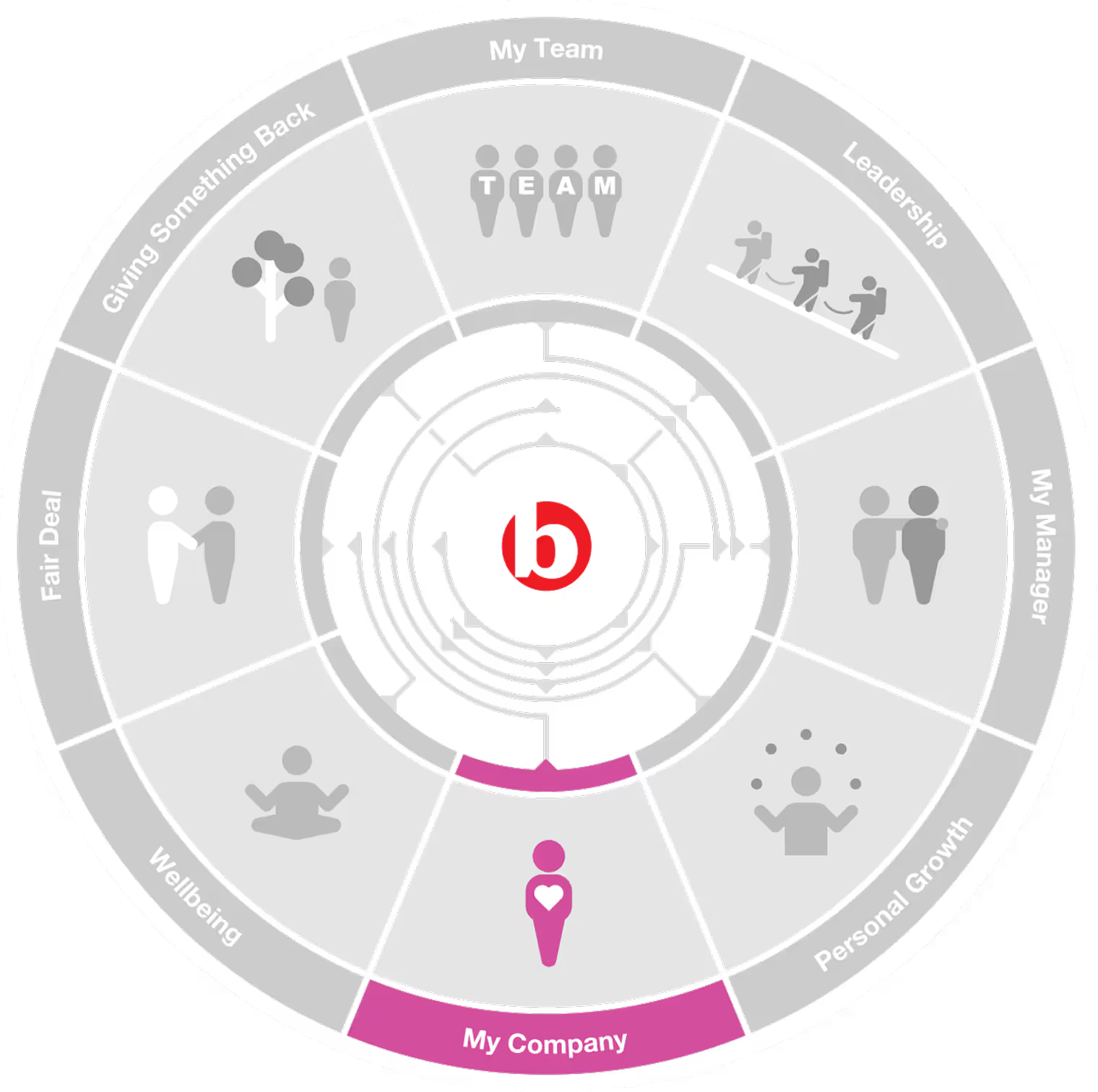
Our approach measures organisational health across eight core areas: My Team, Leadership, My Manager, Personal Growth, My Company, Wellbeing, Fair Deal, and Giving Something Back. Together, they give you a complete view of how your people think, feel, and experience work.
Complete the form and take the first step toward a stronger, more engaged organisation.